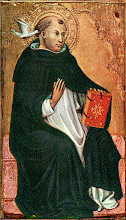
Why this Question Matters.
In Question 20 Aquinas introduced the idea of love in God. In treating of the topic, it became clear that the most important consideration was to understand the way in which we attribute love to God. We have to be careful with the meaning of terms applied to God and to man, understanding the analogies and dis-analogies in their uses. In this question Aquinas turns to the ideas of justice and mercy in God. In scripture and in the liturgy, these are terms that are sometimes applied to God in the same breath in which love is attributed to God, so it is not surprising that Aquinas follows the same strategy in this question as he did in the last. In asking whether there is justice and/or mercy in God, the answer is clear “yes”, but the substance of the question is really to understand what it means to attribute justice and mercy to God.
The Thread of the Argument
A1: As indicated above, Aquinas’s first task is to not really to answer the question “Is God just?” but rather to understand the way in which the term “justice” may be attributed to God. The objections focus on meanings and properties of the notion of justice that would seem to be incompatible with being an attribute of God. For example, justice is a part of the virtue of temperance (which is to do with the passions); justice would seem to circumscribe free action; justice is to do with rendering what is due to individuals. Each of these is prima facie incompatible with some property of God already described by Aquinas. In his answer, Aquinas identifies two types of justice: “commutative justice”, which is to do with agreements between people; and “distributive justice”, that deals with the distribution of what is due to people on the basis of merit (in its widest sense). We cannot attribute commutative justice to God (as there can be no proportion between God and man) but God’s justice is paradigmatically distributive justice, as “God bestows on everything what is proper to each”. In answer to the objections, Aquinas identified that some of the moral virtues are associated with the passions (and for these we must attribute such virtues to God only metaphorically) but others are associated with the will and these can be attributed (carefully) to God. Also, although justice might seem to circumscribe free action for humans, when we consider God it is better to consider His free action as willing what is just by definition. The objection that justice is about rendering what is due is based on the argument that God is a debtor to no creature. Aquinas identifies that God orders creation to Himself and that in doing so He gives to creatures what they need in order to fulfil their place in that order. In this sense, these things are due to creatures so that they can fulfil their natural function. However, we might also note that in giving creatures what they need in order to fulfil their natural order, God is honouring His own ordering of creation. In a sense, God is giving what is due to God rather than simply what is due to creatures.
A2: Aquinas now inquires into the relationship between truth and God’s justice. He recalls that truth is a matching between mind and reality (Question 16, Article 1) and observes that when the mind concerned is creative, the mind is the rule by which reality is judged but that when the mind is not creative the reverse holds. So for us, truth consists of a matching of our minds to things; for God, truth consists in things matching His mind. God’s justice orders things according to His wisdom and therefore we can consider God’s justice to be truth.
A3: Having dealt with justice, Aquinas now inquires into the nature of God’s mercy. Mercy might be seen as being an emotional response; it might also be seen as a relaxing (and therefore a falling short from) justice. These would suggest that God cannot be merciful. Aquinas answers that the “sadness” that we feel when we act mercifully is a result of the compassion that motivates mercy. God, of course, feels no sadness but He acts to drive away imperfections in creatures by the perfection of their goodness. In doing so when it might appear that such gifts are not due to people, God is not acting contrary to justice but acting beyond and above justice. If one pays back a debt, it is not unjust to add a gift to the repayment.
A4: Are justice and mercy simultaneously present in all of God’s works? Scripture might seem to provide examples where only one of these is present in specific circumstances. Similarly, suffering in this world may seem to give an example of injustice in God’s works. Aquinas answers that since God can do nothing that conflicts with His wisdom and goodness and that all that He does is in proportion to what he has ordered, everything He does, He does with justice. He also observes that everything that is due to a creature can be traced back ultimately to God’s will and, foundationally, God’s goodness maintains everything in existence. Therefore God’s mercy is present in all of His works insofar as He provides their very source by His goodness. If scripture sometimes speaks of a work of God as being simply a work of His justice, it is due to the fact that His justice is sometimes more evident in such works. For example, even in the damnation of the reprobate their punishment is sometimes softened by His mercy. Suffering in this world might appear unjust, but can still be seen to exhibit God’s justice and mercy insofar as through suffering people may be lifted closer to God.
Sunday, 11 July 2010

Thursday, 1 July 2010
Question 20 - God's Love
Why this Question Matters.
Love is fundamental and we know from scripture that God loves, that “God is love” even. However, given the picture of God that Aquinas has built up for us over the preceding questions, it is not entirely obvious what this means. In this question, Aquinas introduces the notion of love in God, relating it to God’s will.
The Thread of the Argument
A1: St John tells us that “God is love” so that asking, as this article does, whether God loves would seem rather strange. But as always, when we use terms about God the meaning of which we have derived from created reality, we must be careful about what is meant. The objections point out that love is a passion involving the capacity to be moved by another; but this makes no sense for God, who is unchanging. Similarly, we understand the attribution of grief or anger to God as being metaphors; why should we not simply consider love metaphorically of God? Aquinas answers that God must love simply because God has will! For any appetite (such as will) love is the first movement of that appetite towards the perceived good. Love is ordered to the good in general and is thus prior to all other movements of the will; such movements presuppose love. In humans, the rational appetite (the will) acts through sensitive appetites, therefore any act of the will is accompanied by corresponding bodily changes (e.g. the heart beats faster; adrenalin prepares the body for physical action). Because of these bodily changes we call movements of the sense appetites “passions”, but we do not apply this term to the movements of the will itself. Since God loves only through movement of the will, God loves without passion. We can speak of God’s love being passionate in a metaphorical way if we wish to, but used in the sense of the movement of the will we should speak of God’s love literally. Similarly, we think of love between humans as associated with each wanting the good for the other; in the case of God’s love for us we can still think in these terms if we remember that the good that God wills is nothing other than Himself. We are present to God in His knowledge; our being is because of His willing the good for us, in Him. Finally, we must note that God loves inasmuch as His will is creative, therefore God’s love extends to all of creation, not just to rational creatures.
A2: God wills some good to all existing things. Since loving something is the same as willing good to that thing, we see that God must love everything. But God’s love is not the same as our love because God’s will is creative. When we love someone, we are reacting to the goodness in that person and we are willing good for that person; but our love is not the direct cause of the good in that person. In contrast, God’s love “pours out and creates the goodness of things”. Pseudo-Dionysius the Areopagite taught that love carries lovers outside themselves and transports them to their beloved. Clearly God is not transported outside Himself, but we can in some way say that He is in ecstasy (from the Greek ek-stasis; “standing outside”) in His creative love inasmuch as His love flows out to things. Love and hate for one object can co-exist insofar as the thing is loved in one respect and hated in another. So God loves sinners insofar as they are created things; but as sinners they are deficient and lack being in some way, and in that respect, God hates them.
A3: God loves everything, but does He love everything equally? Aquinas makes a distinction: The act of willing itself can admit degrees of intensity; the good which is willed can be for a greater or lesser good. Aquinas argues that in the first sense God’s love extends equally to all things; God loves everything by one simple act of will. However, in the second sense, God wills a greater good for some things than for others. In this sense, we can say that God loves some things more than others.
A4: Having shown that there is a sense in which God can be said to love some things more than others, Aquinas now passes to the question of whether he loves good things more than bad things. Given the preparation done so far, the answer to this question is almost immediate: God’s loving something more is nothing other than His willing more good upon that thing, therefore he loves good things more. The objections to this article list a number of instances, mostly scriptural, where it would seem that God has a “preferential option for the bad”. Aquinas’s answers to these objections show where each objection has missed certain key elements to arrive at misconception. The interesting exception to this pattern is the example of SS. Peter & John given in objection 3: it appears that St. Peter is better than St. John but equally it appears that Jesus loves St John more than St Peter. In his reply, Aquinas lists all the standard answers to this objection but then says that he thinks it to be “presumptuous to pronounce on all this” and that “the Lord is the weigher of spirits”. Aquinas appears to believe that here the interpretation of scripture is beyond human certainty.
Difficulties
Love is fundamental and we know from scripture that God loves, that “God is love” even. However, given the picture of God that Aquinas has built up for us over the preceding questions, it is not entirely obvious what this means. In this question, Aquinas introduces the notion of love in God, relating it to God’s will.
The Thread of the Argument
A1: St John tells us that “God is love” so that asking, as this article does, whether God loves would seem rather strange. But as always, when we use terms about God the meaning of which we have derived from created reality, we must be careful about what is meant. The objections point out that love is a passion involving the capacity to be moved by another; but this makes no sense for God, who is unchanging. Similarly, we understand the attribution of grief or anger to God as being metaphors; why should we not simply consider love metaphorically of God? Aquinas answers that God must love simply because God has will! For any appetite (such as will) love is the first movement of that appetite towards the perceived good. Love is ordered to the good in general and is thus prior to all other movements of the will; such movements presuppose love. In humans, the rational appetite (the will) acts through sensitive appetites, therefore any act of the will is accompanied by corresponding bodily changes (e.g. the heart beats faster; adrenalin prepares the body for physical action). Because of these bodily changes we call movements of the sense appetites “passions”, but we do not apply this term to the movements of the will itself. Since God loves only through movement of the will, God loves without passion. We can speak of God’s love being passionate in a metaphorical way if we wish to, but used in the sense of the movement of the will we should speak of God’s love literally. Similarly, we think of love between humans as associated with each wanting the good for the other; in the case of God’s love for us we can still think in these terms if we remember that the good that God wills is nothing other than Himself. We are present to God in His knowledge; our being is because of His willing the good for us, in Him. Finally, we must note that God loves inasmuch as His will is creative, therefore God’s love extends to all of creation, not just to rational creatures.
A2: God wills some good to all existing things. Since loving something is the same as willing good to that thing, we see that God must love everything. But God’s love is not the same as our love because God’s will is creative. When we love someone, we are reacting to the goodness in that person and we are willing good for that person; but our love is not the direct cause of the good in that person. In contrast, God’s love “pours out and creates the goodness of things”. Pseudo-Dionysius the Areopagite taught that love carries lovers outside themselves and transports them to their beloved. Clearly God is not transported outside Himself, but we can in some way say that He is in ecstasy (from the Greek ek-stasis; “standing outside”) in His creative love inasmuch as His love flows out to things. Love and hate for one object can co-exist insofar as the thing is loved in one respect and hated in another. So God loves sinners insofar as they are created things; but as sinners they are deficient and lack being in some way, and in that respect, God hates them.
A3: God loves everything, but does He love everything equally? Aquinas makes a distinction: The act of willing itself can admit degrees of intensity; the good which is willed can be for a greater or lesser good. Aquinas argues that in the first sense God’s love extends equally to all things; God loves everything by one simple act of will. However, in the second sense, God wills a greater good for some things than for others. In this sense, we can say that God loves some things more than others.
A4: Having shown that there is a sense in which God can be said to love some things more than others, Aquinas now passes to the question of whether he loves good things more than bad things. Given the preparation done so far, the answer to this question is almost immediate: God’s loving something more is nothing other than His willing more good upon that thing, therefore he loves good things more. The objections to this article list a number of instances, mostly scriptural, where it would seem that God has a “preferential option for the bad”. Aquinas’s answers to these objections show where each objection has missed certain key elements to arrive at misconception. The interesting exception to this pattern is the example of SS. Peter & John given in objection 3: it appears that St. Peter is better than St. John but equally it appears that Jesus loves St John more than St Peter. In his reply, Aquinas lists all the standard answers to this objection but then says that he thinks it to be “presumptuous to pronounce on all this” and that “the Lord is the weigher of spirits”. Aquinas appears to believe that here the interpretation of scripture is beyond human certainty.
Difficulties
- According to Aquinas, love is a movement of the will towards the good and its existence appears to be simply a corollary of the existence of will. When he talks about love in God, Aquinas can apply this notion of love to the movement of God’s will, neatly sidestepping some of the obvious problems that a naïve understanding of love applied to God would throw up. According to Aquinas, “God loves without passion”. This may be a challenge to many people! But here we have to remember how different God is to us and that we understand God through analogy with His creation. Inevitably some of the things we associate with love will not survive the analogy.
- In Article 2 Aquinas is willing to assert that there is sense in which God hates sinners (and in this he follows a distinct line of witness in scripture). We are very used to the slogan “Hate the sin but love the sinner” (somewhat akin to a saying of St. Augustine: “with love for mankind and hatred of sins”), so Aquinas may seem harsh here. But his approach recognizes a more sophisticated approach to love and hate in which they can co-exist under different aspects. A quick search around the web will reveal how much controversy the simple slogan arouses!
Wednesday, 30 June 2010
Question 19 - God's Will
Why this Question Matters.
Man is made in God’s image and therefore it seems reasonable to inquire as to how much we can infer about God by analogy with man. Aquinas has already talked about God’s intellect in his discussion of knowledge in God, so it quite reasonable for him now to consider whether God has a will and if so, how we are to understand it. That God has a will appears to be affirmed by Scripture; but are we to take this as a literal description or as a metaphor? How also do we reconcile the contingency of events within creation with the will of an infinitely powerful being, the fulfilment of which would seem to be inevitable?
The Thread of the Argument
A1: Aquinas devotes the first article to the fundamental question of whether God has a will. If we work by analogy with certain aspects of human willing, this might seem problematic. In humans, will is associated with aiming at some good or with desire for something not possessed, and is at the very least associated with changing some state of affairs for some perceived better state of affairs. Since God is pure actuality, these would be problematic for such a notion of will in God. Scripture, of course, talks of God’s will and of God’s willing certain things, so how are these reconciled? Aquinas affirmation that God has a will is based on an argument that intellect and will necessarily co-exist in a rational mind. Since God is rational and has an intellect, He must therefore also have a will. In support of this argument, Aquinas recalls that physical things have existence through their form and that they tend to the possession of that form if they don’t fully possess it and they rest in it when they do. In a similar way when a mind understands something by possession of its intelligible form, it perceives it as a good to be gained (insofar as it is a good) and tends towards that good. The will simply is this appetite for the perceived good. (The will is sometimes referred to as the “rational appetite”). Replying to the objections, Aquinas argues that the notion of willing is not restricted to unattained things. The aim of God’s will is Himself; His desiring is His love and delight for Himself.
A2: The answer to the first article may leave us with the impression that God’s will is entirely focussed inwardly and that therefore God does not will things other than Himself. Aquinas’s answer to this is based on one of his most profound and beautiful axioms: “good is diffusive of itself”. Things in nature not only have a natural tendency towards their own good but they also spread their own good to other things. For example, animals not only tend towards their own perfection, but they reproduce, spreading their own good to new beings. We know God through his creation, so we may infer that this axiom applies to creation because it applies primarily to God Himself. We may apply this axiom to wills and willing: wills share their good with others and this latter applies pre-eminently to God’s will. In reply to the potent objection that will is stirred, and therefore changed, by what is willed, Aquinas replies that God wills things other than Himself in willing His own goodness. This is parallel to the argument that God understands things other than Himself in understanding His own essence.
A3: Since God is eternal and unchangeable, it might seem in consequence that everything He wills is willed necessarily. For if His will were contingent and truly open to alternatives, this would imply change in God (at the point at which the choice between alternatives occurs) as well as imperfection (as everything contingent has not achieved full actuality). Aquinas answers by making a technical distinction between “absolute necessity” and “hypothetical necessity” in propositions. In the former the relationship between the terms of the proposition guarantee its truth (e.g. “a human being is an animal”); in the latter the proposition is true as it affirms an actual current state of affairs (“Socrates is sitting” is true if Socrates is actually sitting now). Aquinas now argues that God does will His own goodness with absolute necessity, but that there are other things that He wills with hypothetical necessity. To do this, Aquinas notes that God wills things other than Himself “insofar as they are set towards His goodness as to their end”. In other words, all things being ordered towards God as their end are actually ordered towards God’s goodness. He notes that some things that lead to an end are necessary for achieving that end and that some that actually occur are not (but are contingently open to alternatives). Applying this to God’s goodness as final end, we conclude that God must will with absolute necessity the former class and with hypothetical necessity the latter class. So, God wills things necessarily insofar as “He wills what He wills”, but not all that He wills is willed with absolute necessity.
A4: We know that God causes all things in the sense of a first cause, but does it make sense to attribute God’s causality to His will? Or is it, as the objections suggest, more fitting to attribute God’s causality to his essence or to his knowledge (as might be suggested by the conclusion of Q14 Article 8)? Aquinas offers three arguments that God’s will is the cause of things. The first argument is based on the definition of will as rational appetite: the will is what gets things done based on the knowledge of the intellect. In creation, any physical agent is preceded by an intelligent agent and since God is first agent, His agency precedes any other. He has intellect and will and therefore He “gets things done” through His will. The second argument attacks the idea that God’s causality proceeds from His nature by arguing that natures act as agents in one single determinate way, the way that is natural to them. But God’s nature is not like the natures of created things; the whole perfection of being is contained in God’s nature and therefore it is not ordered to one determinate thing. The analogy between God’s nature and created natures breaks down before we can claim natural causation associated with God’s nature. The third argument mirrors the first in arguing that effects pre-exist in their causes and therefore creatures pre-exist in God’s understanding. They proceed from this pre-existence in His understanding by His will, as will is the faculty of the mind that tends towards the good perceived.
A5: God is the first cause, so it makes little sense to talk of His causing being caused by something else. But can we look for causal structure in God’s will, attributing cause to certain acts of His will due to other acts of His will? If there were no cause behind all of God’s willed actions one might begin to think of God as capricious or even irrational! To answer this question, Aquinas considers a certain aspect of how minds work. Sometimes, he claims, we understand a premise and draw a conclusion from it as separate acts. Other times we grasp both a premise and conclusion together in a single act of intuition. In the latter case we do not say that understanding of the premise causes understanding of the conclusion but we do in the former case. The will behaves in a similar fashion with respect to ends and means. If end and means are grasped in one act, then we do not say that willing the end causes the willing of the means. God, of course, wills everything in His Goodness in a single act, therefore His willing of an end cannot be said to be a cause of His willing the corresponding means. Hence Aquinas concludes that He does not will this because He wills that but rather that He wills this to be because of that.
A6: We might initially think that God’s will must of necessity be fulfilled; after all, whatever could frustrate it? But St. Paul famously wrote that “God wills everyone to be saved and to come to know the truth”, but things do not turn out that way, implying that God’s will can be frustrated. Aquinas affirm that God’s will is inevitably fulfilled, but in doing so he also reaffirms the classical notions of “antecedent will” and "consequent will” in his reply to the objection concerning the failure of universal salvation. He starts by drawing a parallel between formal and efficient causes. A thing can fail to have a particular form, but it cannot fail to have a form. Likewise something can fail to have a particular efficient cause but it must still have a cause subsumed under the universal first cause. No effect can escape from being under the sway of the universal cause. Therefore, as the universal cause of all things, God’s will must be fulfilled; if His will appears to be frustrated from one point of view, it is in fact fulfilled from another point of view. To understand the difference between antecedent and consequent will, Aquinas gives the example that it is good in general that people should live and bad for them to die. However, if they turn out to be murderers then it is good that they should be killed. (Our modern sensibilities might wish to replace Aquinas’s example with freedom and incarceration rather than life and execution!) An antecedent will is a sort of willing that is expressed prior to considering all the facts of a particular situation. When all those facts are taken into account, a judgement is expressed in consequent willing. So, the classical tradition is that St Paul’s words are expressing God’s antecedent will rather than His consequent will, where His justice and mercy will be in balance according His revealed promises.
A7: From certain passages of scripture it might seem that God’s will is changeable. However, there are also other scriptural passages that assert that God’s will is unchangeable. How are we to understand this? Aquinas, as one might expect by now, is firmly on the side of the teaching that God’s will is unchanging. He notes first of all that there is a substantial difference between changing one’s will and willing change. One must also note that even in humans an unchanging will can will contrary things to happen in different circumstances. Aquinas explains those scriptural passages that seem to assert a change in God’s will as invoking metaphor or as, in the words of Gregory the Great, “God changes his sentence, but not His plan”. Things can appear to us as changing when they are in fact unchanging as far as God is concerned.
A8: Aquinas asked whether God wills necessarily in Article 2. He now returns to the question of necessity in God’s will in an article related to the subject of article 6: Does God’s will impose necessity on the things He wills? If this were so, then it would appear that any notion of contingency or of free choice would disappear. Aquinas claims that God’s will sometimes imposes necessity on the things He wills and sometimes it does not. In defending this position, Aquinas rejects a common argument that says that effects are necessary when God uses necessary secondary causes and are contingent when He uses contingent secondary causes (recall his argument in Article 6 that God’s will is always inevitable fulfilled). Instead, Aquinas argues the other way around. As God’s will is the most effective of all causes, God can not only will things to be but can also will the way in which they come to be. Thus in designing the universe, God has ordered necessary causes for some effects and contingent causes for other effects.
A9: In Question 14 Article 10, Aquinas tackled the awkward question of God’s knowledge of evil. There he had to deal with the objection that as God’s knowledge is creative, it might seem that God must therefore create evil. Now Aquinas turns his attention to the question of whether God wills evil. Again, the naive challenge here is that God is responsible for everything and that everything that is has resulted from His will, therefore it would seem that He must will the evils that are present in creation. Aquinas argues (from Question 5 Article 1) that as evil is the opposite of the good, it is impossible that any evil can be directly wanted, be it by the natural appetite, animal appetite or by the rational appetite that is the will. However, it is possible for evil to be willed indirectly when the evil corresponds in some natural way to a greater good. For example, a lion killing a deer to eat involves the evil of death but the evil is associated with the good of the flourishing of the lion. God never wills moral evil but He wills physical evil indirectly by willing the good with which it is associated.
A10: Does God have free choice? Article 3 argued that God wills His own good of necessity but that the other things He wills are only willed with a hypothetical necessity. God clearly has choice over willing these latter things. Now God cannot choose moral evil (as argued in Article 9) but this is, by definition, a turning away from the good and is therefore consistent with God’s free choice over hypothetical necessities.
A11: We can often infer a state of mind in someone from their behaviour. For example, it is often reasonable to infer that someone is angry if they punish their child. We can also sometimes infer someone’s will from what they do or say. We say that the behaviour is a sign of the underlying state of mind. Can we do the same with God’s will? Can we infer God’s will from some of the signs that He gives? Aquinas argues that we can, but he also warns that we often use metaphor in the inference, as God is in many ways quite unlike the way we are. For example, scripture talks of God being angry and of God’s wrath; these are metaphorical applications to God of human emotions which point to some underlying reality. God issues commands from which we may reasonably infer God’s will. There is a difference between these examples: we attribute anger to God metaphorically but sometimes we can attribute willing to God literally. Indeed, we have to be careful in our inference, distinguishing literal willing of God (His “will of good pleasure”) from a metaphorical attribution (a “will of sign”).
A12: Having argued for the possibility of inferring God’s will from signs, Aquinas now proposes five particular signs that are amenable to such inference. He arrives at these signs by analogy with human willing. If you want something done, then doing it yourself, or getting it done by someone else expresses your will; therefore doing is sign of will. If you give permission for something to be done, that is a sign of your will. Likewise prohibiting something indicates your will on the matter. We might direct others through an imperative precept or through an advisory council. Aquinas argues that the analogy with human willing is valid by an appeal to the Lord’s Prayer and to an argument of Augustine.
Handy Concepts
Difficulties
Man is made in God’s image and therefore it seems reasonable to inquire as to how much we can infer about God by analogy with man. Aquinas has already talked about God’s intellect in his discussion of knowledge in God, so it quite reasonable for him now to consider whether God has a will and if so, how we are to understand it. That God has a will appears to be affirmed by Scripture; but are we to take this as a literal description or as a metaphor? How also do we reconcile the contingency of events within creation with the will of an infinitely powerful being, the fulfilment of which would seem to be inevitable?
The Thread of the Argument
A1: Aquinas devotes the first article to the fundamental question of whether God has a will. If we work by analogy with certain aspects of human willing, this might seem problematic. In humans, will is associated with aiming at some good or with desire for something not possessed, and is at the very least associated with changing some state of affairs for some perceived better state of affairs. Since God is pure actuality, these would be problematic for such a notion of will in God. Scripture, of course, talks of God’s will and of God’s willing certain things, so how are these reconciled? Aquinas affirmation that God has a will is based on an argument that intellect and will necessarily co-exist in a rational mind. Since God is rational and has an intellect, He must therefore also have a will. In support of this argument, Aquinas recalls that physical things have existence through their form and that they tend to the possession of that form if they don’t fully possess it and they rest in it when they do. In a similar way when a mind understands something by possession of its intelligible form, it perceives it as a good to be gained (insofar as it is a good) and tends towards that good. The will simply is this appetite for the perceived good. (The will is sometimes referred to as the “rational appetite”). Replying to the objections, Aquinas argues that the notion of willing is not restricted to unattained things. The aim of God’s will is Himself; His desiring is His love and delight for Himself.
A2: The answer to the first article may leave us with the impression that God’s will is entirely focussed inwardly and that therefore God does not will things other than Himself. Aquinas’s answer to this is based on one of his most profound and beautiful axioms: “good is diffusive of itself”. Things in nature not only have a natural tendency towards their own good but they also spread their own good to other things. For example, animals not only tend towards their own perfection, but they reproduce, spreading their own good to new beings. We know God through his creation, so we may infer that this axiom applies to creation because it applies primarily to God Himself. We may apply this axiom to wills and willing: wills share their good with others and this latter applies pre-eminently to God’s will. In reply to the potent objection that will is stirred, and therefore changed, by what is willed, Aquinas replies that God wills things other than Himself in willing His own goodness. This is parallel to the argument that God understands things other than Himself in understanding His own essence.
A3: Since God is eternal and unchangeable, it might seem in consequence that everything He wills is willed necessarily. For if His will were contingent and truly open to alternatives, this would imply change in God (at the point at which the choice between alternatives occurs) as well as imperfection (as everything contingent has not achieved full actuality). Aquinas answers by making a technical distinction between “absolute necessity” and “hypothetical necessity” in propositions. In the former the relationship between the terms of the proposition guarantee its truth (e.g. “a human being is an animal”); in the latter the proposition is true as it affirms an actual current state of affairs (“Socrates is sitting” is true if Socrates is actually sitting now). Aquinas now argues that God does will His own goodness with absolute necessity, but that there are other things that He wills with hypothetical necessity. To do this, Aquinas notes that God wills things other than Himself “insofar as they are set towards His goodness as to their end”. In other words, all things being ordered towards God as their end are actually ordered towards God’s goodness. He notes that some things that lead to an end are necessary for achieving that end and that some that actually occur are not (but are contingently open to alternatives). Applying this to God’s goodness as final end, we conclude that God must will with absolute necessity the former class and with hypothetical necessity the latter class. So, God wills things necessarily insofar as “He wills what He wills”, but not all that He wills is willed with absolute necessity.
A4: We know that God causes all things in the sense of a first cause, but does it make sense to attribute God’s causality to His will? Or is it, as the objections suggest, more fitting to attribute God’s causality to his essence or to his knowledge (as might be suggested by the conclusion of Q14 Article 8)? Aquinas offers three arguments that God’s will is the cause of things. The first argument is based on the definition of will as rational appetite: the will is what gets things done based on the knowledge of the intellect. In creation, any physical agent is preceded by an intelligent agent and since God is first agent, His agency precedes any other. He has intellect and will and therefore He “gets things done” through His will. The second argument attacks the idea that God’s causality proceeds from His nature by arguing that natures act as agents in one single determinate way, the way that is natural to them. But God’s nature is not like the natures of created things; the whole perfection of being is contained in God’s nature and therefore it is not ordered to one determinate thing. The analogy between God’s nature and created natures breaks down before we can claim natural causation associated with God’s nature. The third argument mirrors the first in arguing that effects pre-exist in their causes and therefore creatures pre-exist in God’s understanding. They proceed from this pre-existence in His understanding by His will, as will is the faculty of the mind that tends towards the good perceived.
A5: God is the first cause, so it makes little sense to talk of His causing being caused by something else. But can we look for causal structure in God’s will, attributing cause to certain acts of His will due to other acts of His will? If there were no cause behind all of God’s willed actions one might begin to think of God as capricious or even irrational! To answer this question, Aquinas considers a certain aspect of how minds work. Sometimes, he claims, we understand a premise and draw a conclusion from it as separate acts. Other times we grasp both a premise and conclusion together in a single act of intuition. In the latter case we do not say that understanding of the premise causes understanding of the conclusion but we do in the former case. The will behaves in a similar fashion with respect to ends and means. If end and means are grasped in one act, then we do not say that willing the end causes the willing of the means. God, of course, wills everything in His Goodness in a single act, therefore His willing of an end cannot be said to be a cause of His willing the corresponding means. Hence Aquinas concludes that He does not will this because He wills that but rather that He wills this to be because of that.
A6: We might initially think that God’s will must of necessity be fulfilled; after all, whatever could frustrate it? But St. Paul famously wrote that “God wills everyone to be saved and to come to know the truth”, but things do not turn out that way, implying that God’s will can be frustrated. Aquinas affirm that God’s will is inevitably fulfilled, but in doing so he also reaffirms the classical notions of “antecedent will” and "consequent will” in his reply to the objection concerning the failure of universal salvation. He starts by drawing a parallel between formal and efficient causes. A thing can fail to have a particular form, but it cannot fail to have a form. Likewise something can fail to have a particular efficient cause but it must still have a cause subsumed under the universal first cause. No effect can escape from being under the sway of the universal cause. Therefore, as the universal cause of all things, God’s will must be fulfilled; if His will appears to be frustrated from one point of view, it is in fact fulfilled from another point of view. To understand the difference between antecedent and consequent will, Aquinas gives the example that it is good in general that people should live and bad for them to die. However, if they turn out to be murderers then it is good that they should be killed. (Our modern sensibilities might wish to replace Aquinas’s example with freedom and incarceration rather than life and execution!) An antecedent will is a sort of willing that is expressed prior to considering all the facts of a particular situation. When all those facts are taken into account, a judgement is expressed in consequent willing. So, the classical tradition is that St Paul’s words are expressing God’s antecedent will rather than His consequent will, where His justice and mercy will be in balance according His revealed promises.
A7: From certain passages of scripture it might seem that God’s will is changeable. However, there are also other scriptural passages that assert that God’s will is unchangeable. How are we to understand this? Aquinas, as one might expect by now, is firmly on the side of the teaching that God’s will is unchanging. He notes first of all that there is a substantial difference between changing one’s will and willing change. One must also note that even in humans an unchanging will can will contrary things to happen in different circumstances. Aquinas explains those scriptural passages that seem to assert a change in God’s will as invoking metaphor or as, in the words of Gregory the Great, “God changes his sentence, but not His plan”. Things can appear to us as changing when they are in fact unchanging as far as God is concerned.
A8: Aquinas asked whether God wills necessarily in Article 2. He now returns to the question of necessity in God’s will in an article related to the subject of article 6: Does God’s will impose necessity on the things He wills? If this were so, then it would appear that any notion of contingency or of free choice would disappear. Aquinas claims that God’s will sometimes imposes necessity on the things He wills and sometimes it does not. In defending this position, Aquinas rejects a common argument that says that effects are necessary when God uses necessary secondary causes and are contingent when He uses contingent secondary causes (recall his argument in Article 6 that God’s will is always inevitable fulfilled). Instead, Aquinas argues the other way around. As God’s will is the most effective of all causes, God can not only will things to be but can also will the way in which they come to be. Thus in designing the universe, God has ordered necessary causes for some effects and contingent causes for other effects.
A9: In Question 14 Article 10, Aquinas tackled the awkward question of God’s knowledge of evil. There he had to deal with the objection that as God’s knowledge is creative, it might seem that God must therefore create evil. Now Aquinas turns his attention to the question of whether God wills evil. Again, the naive challenge here is that God is responsible for everything and that everything that is has resulted from His will, therefore it would seem that He must will the evils that are present in creation. Aquinas argues (from Question 5 Article 1) that as evil is the opposite of the good, it is impossible that any evil can be directly wanted, be it by the natural appetite, animal appetite or by the rational appetite that is the will. However, it is possible for evil to be willed indirectly when the evil corresponds in some natural way to a greater good. For example, a lion killing a deer to eat involves the evil of death but the evil is associated with the good of the flourishing of the lion. God never wills moral evil but He wills physical evil indirectly by willing the good with which it is associated.
A10: Does God have free choice? Article 3 argued that God wills His own good of necessity but that the other things He wills are only willed with a hypothetical necessity. God clearly has choice over willing these latter things. Now God cannot choose moral evil (as argued in Article 9) but this is, by definition, a turning away from the good and is therefore consistent with God’s free choice over hypothetical necessities.
A11: We can often infer a state of mind in someone from their behaviour. For example, it is often reasonable to infer that someone is angry if they punish their child. We can also sometimes infer someone’s will from what they do or say. We say that the behaviour is a sign of the underlying state of mind. Can we do the same with God’s will? Can we infer God’s will from some of the signs that He gives? Aquinas argues that we can, but he also warns that we often use metaphor in the inference, as God is in many ways quite unlike the way we are. For example, scripture talks of God being angry and of God’s wrath; these are metaphorical applications to God of human emotions which point to some underlying reality. God issues commands from which we may reasonably infer God’s will. There is a difference between these examples: we attribute anger to God metaphorically but sometimes we can attribute willing to God literally. Indeed, we have to be careful in our inference, distinguishing literal willing of God (His “will of good pleasure”) from a metaphorical attribution (a “will of sign”).
A12: Having argued for the possibility of inferring God’s will from signs, Aquinas now proposes five particular signs that are amenable to such inference. He arrives at these signs by analogy with human willing. If you want something done, then doing it yourself, or getting it done by someone else expresses your will; therefore doing is sign of will. If you give permission for something to be done, that is a sign of your will. Likewise prohibiting something indicates your will on the matter. We might direct others through an imperative precept or through an advisory council. Aquinas argues that the analogy with human willing is valid by an appeal to the Lord’s Prayer and to an argument of Augustine.
Handy Concepts
- The will is the “rational appetite” corresponding to the intellect. The intellect perceives something as a good to be desired and proposes it as such to the will. The will takes this proposal as its object and moves towards it in a fashion parallel to the way our other appetites move towards their objects.
- “Appetites” can be rational (as with the will) or can be “sensitive” (corresponding to the senses). The term is also applied to non-living things in that they tend towards their perfection. So, in article 1, Aquinas states that “When cognition is absent we call this bearing ‘natural appetite’”.
- In the second objection to Article 5, Aquinas touches on the idea that God is the immediate cause of all things in the created world through His will. This idea became popular in some branches of Islamic philosophy.
- For Aquinas, intellect precedes the will (i.e. the intellect identifies an object for the will as a perceived good and the will tends towards that object). Later medieval philosophers argued for the primacy of the will. This led to the idea of voluntarism (which some consider one of the formative ideas behind the Reformation).
Difficulties
- Articles 6 & 8 together seem puzzling. God’s will is always fulfilled and God orders necessary effects through necessary causes and contingent effects through contingent causes. How does this work? Does Aquinas’s use of the word “contingent” really make any sense? What does it mean to say that God can will the manner (necessary or contingent) in which things come about? How can God “prepare contingent causes”? He will return to this theme in Q 22 on God’s providence.
Saturday, 12 June 2010
Question 18 - God's Life
Why this Question Matters.
Understanding, knowledge and intellect are things that we usually attribute to living beings, therefore it would seem natural to attribute “life” to God Himself. Indeed, scripture itself attributes life to God in a number of places. We’re already aware of the need to understand the use of analogy where predicates attributed to God are based on human experience, so how does this apply the predicate “living”?
The Thread of the Argument
A1: First of all, we must be clear about what we consider life to be on the basis of natural experience. The question asked in the first article may seem rather strange: “Are all natural things alive?” However the point of the question is to allow Aquinas to make the distinction between things that move (the claim made in the objections is that all natural things can move and are therefore alive) and things that move themselves. Aquinas claims that we can distinguish living things from non-living things on the basis of their ability to move themselves.
A2: Asking what life consists in is one of those perennial questions, beloved in recent years by mass market lifestyle gurus. Aquinas points out that there is a serious side to it: is living something that we do (an activity) or is it part of our being? Aquinas is quite clear that although we pursue activity while we are alive, there is more to life than simply this. His reasoning follows the idea of inferring essences from substantial accidents that we’ve noted in the “metaphysics” document. Here, in accordance with the answer in the first article, we ascribe life to things according to their movements or their activities. But we mustn’t mistake these properties for the underlying essence. Aquinas tells us that “living” is a substantial predicate; in other words, it points to the underlying essence (the very being itself). He is willing to concede that, linguistically, we do use the word “living” in a less proper sense to describe those activities that living beings pursue.
A3: Having dealt with the preliminaries, Aquinas can turn to the question of how we attribute life to God. However, having associated life with self-movement, he now faces the objection that God although moving others, is Himself unmoving! To get out of this conundrum, Aquinas observes a hierarchy in living beings associated with the degree to which they act of themselves. For the lowest forms of life, such as plants, their movement (such as growth or response to the sun) is determined for them by the forms that nature has endowed them with. For animals, the next step up the hierarchy, movement is determined not only by the form that they are endowed with but by the forms that they receive through the senses. Even within the class of animals there is a hierarchy according to the perfection of their sense abilities – so oysters are “lower” animals than dogs, for example. Animals react to instinct and external stimuli, but humans go one further than that: they have ends which they determine for themselves. Reason and intellect allow us to connect means and ends to achieve our goals. But even humans do not provide either first principles or their final end. At the top of the hierarchy is God who does not have anything supplied to Him by another and therefore God possesses life to the fullest degree. Throughout the argument, Aquinas has made a subtle generalization from identifying life with physical self-movement to identifying it with degrees of self-actualization. God, being pure actuality, is therefore “living” in the fullest meaning of the term and our analogical use of the word for creatures gets specialized to self-movement.
A4: God’s nature is His own act of understanding and we must also understand His life to be His understanding (from what has been said in the previous article). Also, we recall that God’s understanding is itself creative. So, “whatever is in God as something understood is His very life” and therefore “in Him all things are His divine life”. In this sense, we can assert that everything in God is life. God holds everything in being and in this sense gives “life” to them; the natures of things that are not in themselves alive are given “life” thought their existence in God’s mind. Aquinas illustrates this idea further in the reply to the third objection. At the level of natures, things have a truer existence in the mind of God (as forms) than they do in themselves; but as individuals (individuated by matter) their individual existence is more truly in themselves than in God’s mind.
Handy Concepts
Understanding, knowledge and intellect are things that we usually attribute to living beings, therefore it would seem natural to attribute “life” to God Himself. Indeed, scripture itself attributes life to God in a number of places. We’re already aware of the need to understand the use of analogy where predicates attributed to God are based on human experience, so how does this apply the predicate “living”?
The Thread of the Argument
A1: First of all, we must be clear about what we consider life to be on the basis of natural experience. The question asked in the first article may seem rather strange: “Are all natural things alive?” However the point of the question is to allow Aquinas to make the distinction between things that move (the claim made in the objections is that all natural things can move and are therefore alive) and things that move themselves. Aquinas claims that we can distinguish living things from non-living things on the basis of their ability to move themselves.
A2: Asking what life consists in is one of those perennial questions, beloved in recent years by mass market lifestyle gurus. Aquinas points out that there is a serious side to it: is living something that we do (an activity) or is it part of our being? Aquinas is quite clear that although we pursue activity while we are alive, there is more to life than simply this. His reasoning follows the idea of inferring essences from substantial accidents that we’ve noted in the “metaphysics” document. Here, in accordance with the answer in the first article, we ascribe life to things according to their movements or their activities. But we mustn’t mistake these properties for the underlying essence. Aquinas tells us that “living” is a substantial predicate; in other words, it points to the underlying essence (the very being itself). He is willing to concede that, linguistically, we do use the word “living” in a less proper sense to describe those activities that living beings pursue.
A3: Having dealt with the preliminaries, Aquinas can turn to the question of how we attribute life to God. However, having associated life with self-movement, he now faces the objection that God although moving others, is Himself unmoving! To get out of this conundrum, Aquinas observes a hierarchy in living beings associated with the degree to which they act of themselves. For the lowest forms of life, such as plants, their movement (such as growth or response to the sun) is determined for them by the forms that nature has endowed them with. For animals, the next step up the hierarchy, movement is determined not only by the form that they are endowed with but by the forms that they receive through the senses. Even within the class of animals there is a hierarchy according to the perfection of their sense abilities – so oysters are “lower” animals than dogs, for example. Animals react to instinct and external stimuli, but humans go one further than that: they have ends which they determine for themselves. Reason and intellect allow us to connect means and ends to achieve our goals. But even humans do not provide either first principles or their final end. At the top of the hierarchy is God who does not have anything supplied to Him by another and therefore God possesses life to the fullest degree. Throughout the argument, Aquinas has made a subtle generalization from identifying life with physical self-movement to identifying it with degrees of self-actualization. God, being pure actuality, is therefore “living” in the fullest meaning of the term and our analogical use of the word for creatures gets specialized to self-movement.
A4: God’s nature is His own act of understanding and we must also understand His life to be His understanding (from what has been said in the previous article). Also, we recall that God’s understanding is itself creative. So, “whatever is in God as something understood is His very life” and therefore “in Him all things are His divine life”. In this sense, we can assert that everything in God is life. God holds everything in being and in this sense gives “life” to them; the natures of things that are not in themselves alive are given “life” thought their existence in God’s mind. Aquinas illustrates this idea further in the reply to the third objection. At the level of natures, things have a truer existence in the mind of God (as forms) than they do in themselves; but as individuals (individuated by matter) their individual existence is more truly in themselves than in God’s mind.
Handy Concepts
- Article 2 relates to the contrast often made between a “mechanical” view of the world, and a world that sees the mechanics as simply part of a wider reality with truth, being, goodness, beauty and unity being key to understanding the world around us. This article is one of those places where Thomas insists that the substance (that is, the very being) of things is not simply their collection of properties. (So, in modern metaphysical jargon, Thomas does not subscribe to a “bundle” theory of ontology). Rather the properties of things (their substantial accidents) point us to their corresponding substances and thus to their being. In this case “living” might appear at first sight to be a property only in the sense of an activity, but to stop there is to miss the point.
Thursday, 3 June 2010
Question 17 - Falsehood
Why this Question Matters.
Having dealt with the truth in Q16, it’s entirely natural that Aquinas should enquire into falsehood in this question. What is it? Where does it exist? and what relation does it have with the truth?
The Thread of the Argument
A1: Aquinas first asks whether falsity exists in things much in the same way as he asked whether truth existed in things or in the intellect in Q16. He affirms that truth and falsity are opposed to one another and that as truth is found primarily in the intellect, we must look there first for falsehood. Similarly, things will be called false in an absolute sense where their existence depends per se (that is, for their very being) on an intellect. For natural things, the intellect concerned is God’s intellect. Now, although we might call an artefact (something we make for a purpose) false if it were a bad example of an artefact, we cannot say the same in the case of things that God makes as He makes them according to the ordination of His intellect (and He makes them as He makes them, however perplexing that may be to us). There is no falsehood in the intellect of God. (Aquinas deals separately with the case of creatures to whom He has given free will and who may sin against His will). But as far as our intellect is concerned, natural things are related per accidens, and although we therefore cannot call them false in an absolute sense, we can call them false in a derived sense. Aquinas identifies two ways in which we can attribute falsity to natural things in this derived fashion. Firstly something can be false with respect to what fails to exist in it (a great tragic actor would make a poor heroic character) and secondly in the sense that it can deceive us as to what it truly is.
A2: Next Aquinas asks whether falsity can exist in the senses. It might seem that falsity can only exist in the interpretation of our sense data rather than in the sense data themselves (as they simply exist prior to interpretation). But Aquinas takes a different view. He says that falsity should be looked for in the senses only to the extent that truth exists in them, so that we can only say that falsity exists in the senses when they apprehend things otherwise than they actually are (so that a false likeness of a thing is produced). He identifies three ways in which likenesses of things exist in the senses: primarily and substantially (such as colour sensations), called “proper sensibles”; secondarily and substantially (such as shape or magnitude sensations), called “common sensibles”; and secondarily and accidentally (such as the sensation of a particular individual thing like a man). He seems to be arguing that senses can operate in more ways that simply the apprehension of primary sensations. They are capable of “pre-processing” primitive sense data before it is presented to the intellect. Therefore falsehood can exist in the first of these only when the sense organ itself is not working properly but can occur in the others when the senses make mistakes in this pre-processing.
A3: We might be tempted to claim that since truth exists primarily in the intellect, we can immediately infer that falsity exists primarily in the intellect. But deception might give an example where falsehood occurs as a privation of understanding, so how can one say that the falsehood exists in the intellect (rather than the truth failing to exist)? In order to address the question of whether falsity exists in the intellect, Aquinas has to enquire into how the intellect might fail. In order to do this he makes a number of parallels. A thing, such as a human, is a composite of form and matter. It is quite possible for that thing to be defective in a number of possible ways; for example a human may be born with only one leg. But that human being is still a human being. It is of the nature of human beings to be two-legged; being two-legged follows on from being a human (in Aristotelian terms it is a “property” of being human). But our human being cannot be defective with respect to the being he or she derives from his or her form; their form (the soul) gives them their essential humanity. If they were defective with respect to this, they would simply not be human beings in the first place but some other sort of being. Similarly, as we saw in article 2, sense organs cannot be “false” in sensing proper sensibles (they simply sense what they sense). In a parallel manner, the first operation of the intellect (see below) is to grasp the quiddity (the “what-ness”) of things; in this, the intellect cannot be deceived as to the quiddity of something. (The intellect is simply informed by the form that it receives; “either it is true or it understands nothing at all”. We’ll hear more about this in Q85.) However, it can be deceived when it starts thinking about this quiddity and can get completely the wrong end of the stick about the thing itself. So, in one sense (in its first operation) the intellect contains no falsity; but it may contain falsity reflecting upon the quiddity it has received. It may also be deceived in identifying what it has perceived: it may simply get the wrong identification; or it may put together incommensurable definitions to end up with nonsense.
A4: In the fourth article, Aquinas asks us to consider the relationship between truth and falsity. One might wish to say they are simply opposites, but Aquinas wishes to be precise about what this means. To do this he runs though a number of possible relationships. We might first think of the idea of “negation”. When we say that something is “not-black” we simply deny that the thing is black. Strictly speaking we say nothing positive about it at all (we might be inclined to think that “not-black” implies some other colour, but this is not necessarily so); negation tells us nothing positive about the subject, it simply denies something. On the other hand, a “privation” tells us about some element missing in something the nature of which it is to have that element. (So “blindness” tells us about something missing in something whose nature it is to see.) A privation determines a subject. Lastly, a “contrary” both determines a subject and tells us something positive about it. For example, “white” is a contrary to “black. Although one might be inclined to think that falsity is a privation of the truth (as evil is the privation of good), Aquinas, following Aristotle, claims that falsity is a contrary to truth because a falsehood posits a definite belief that does not correspond to its subject.
Handy Concepts
Difficulties
Having dealt with the truth in Q16, it’s entirely natural that Aquinas should enquire into falsehood in this question. What is it? Where does it exist? and what relation does it have with the truth?
The Thread of the Argument
A1: Aquinas first asks whether falsity exists in things much in the same way as he asked whether truth existed in things or in the intellect in Q16. He affirms that truth and falsity are opposed to one another and that as truth is found primarily in the intellect, we must look there first for falsehood. Similarly, things will be called false in an absolute sense where their existence depends per se (that is, for their very being) on an intellect. For natural things, the intellect concerned is God’s intellect. Now, although we might call an artefact (something we make for a purpose) false if it were a bad example of an artefact, we cannot say the same in the case of things that God makes as He makes them according to the ordination of His intellect (and He makes them as He makes them, however perplexing that may be to us). There is no falsehood in the intellect of God. (Aquinas deals separately with the case of creatures to whom He has given free will and who may sin against His will). But as far as our intellect is concerned, natural things are related per accidens, and although we therefore cannot call them false in an absolute sense, we can call them false in a derived sense. Aquinas identifies two ways in which we can attribute falsity to natural things in this derived fashion. Firstly something can be false with respect to what fails to exist in it (a great tragic actor would make a poor heroic character) and secondly in the sense that it can deceive us as to what it truly is.
A2: Next Aquinas asks whether falsity can exist in the senses. It might seem that falsity can only exist in the interpretation of our sense data rather than in the sense data themselves (as they simply exist prior to interpretation). But Aquinas takes a different view. He says that falsity should be looked for in the senses only to the extent that truth exists in them, so that we can only say that falsity exists in the senses when they apprehend things otherwise than they actually are (so that a false likeness of a thing is produced). He identifies three ways in which likenesses of things exist in the senses: primarily and substantially (such as colour sensations), called “proper sensibles”; secondarily and substantially (such as shape or magnitude sensations), called “common sensibles”; and secondarily and accidentally (such as the sensation of a particular individual thing like a man). He seems to be arguing that senses can operate in more ways that simply the apprehension of primary sensations. They are capable of “pre-processing” primitive sense data before it is presented to the intellect. Therefore falsehood can exist in the first of these only when the sense organ itself is not working properly but can occur in the others when the senses make mistakes in this pre-processing.
A3: We might be tempted to claim that since truth exists primarily in the intellect, we can immediately infer that falsity exists primarily in the intellect. But deception might give an example where falsehood occurs as a privation of understanding, so how can one say that the falsehood exists in the intellect (rather than the truth failing to exist)? In order to address the question of whether falsity exists in the intellect, Aquinas has to enquire into how the intellect might fail. In order to do this he makes a number of parallels. A thing, such as a human, is a composite of form and matter. It is quite possible for that thing to be defective in a number of possible ways; for example a human may be born with only one leg. But that human being is still a human being. It is of the nature of human beings to be two-legged; being two-legged follows on from being a human (in Aristotelian terms it is a “property” of being human). But our human being cannot be defective with respect to the being he or she derives from his or her form; their form (the soul) gives them their essential humanity. If they were defective with respect to this, they would simply not be human beings in the first place but some other sort of being. Similarly, as we saw in article 2, sense organs cannot be “false” in sensing proper sensibles (they simply sense what they sense). In a parallel manner, the first operation of the intellect (see below) is to grasp the quiddity (the “what-ness”) of things; in this, the intellect cannot be deceived as to the quiddity of something. (The intellect is simply informed by the form that it receives; “either it is true or it understands nothing at all”. We’ll hear more about this in Q85.) However, it can be deceived when it starts thinking about this quiddity and can get completely the wrong end of the stick about the thing itself. So, in one sense (in its first operation) the intellect contains no falsity; but it may contain falsity reflecting upon the quiddity it has received. It may also be deceived in identifying what it has perceived: it may simply get the wrong identification; or it may put together incommensurable definitions to end up with nonsense.
A4: In the fourth article, Aquinas asks us to consider the relationship between truth and falsity. One might wish to say they are simply opposites, but Aquinas wishes to be precise about what this means. To do this he runs though a number of possible relationships. We might first think of the idea of “negation”. When we say that something is “not-black” we simply deny that the thing is black. Strictly speaking we say nothing positive about it at all (we might be inclined to think that “not-black” implies some other colour, but this is not necessarily so); negation tells us nothing positive about the subject, it simply denies something. On the other hand, a “privation” tells us about some element missing in something the nature of which it is to have that element. (So “blindness” tells us about something missing in something whose nature it is to see.) A privation determines a subject. Lastly, a “contrary” both determines a subject and tells us something positive about it. For example, “white” is a contrary to “black. Although one might be inclined to think that falsity is a privation of the truth (as evil is the privation of good), Aquinas, following Aristotle, claims that falsity is a contrary to truth because a falsehood posits a definite belief that does not correspond to its subject.
Handy Concepts
- As we’ve seen before. Aquinas understands the intellect as composed of an active (agent) part and a passive part. He also sees the operation of the intellect divided into two. The first act of the intellect (also called simple apprehension) is that by which the intellect knows what a thing is (its quiddity) without affirming or denying anything of it. The second operation of the intellect (also known as judgement) involves the intellect affirming or denying things of it by a process of composing or dividing. It is in the second operation of the intellect that we grasp the being (the esse) of something.
- Aquinas also divides the operation of the senses into the apprehension of “proper sensibles” that are the basic sense data from each individual sense organ (i.e. so colour is proper to the sense of sight) and “common sensibles” that are those things apprehended by more than one sense organ. (Movement, for example can be seen and felt). He calls these two “per se” (or substantial). He also identifies “per accidens” (“accidental”) objects of the senses that correspond to what you or I might think of “things” like a bowl of sugar. For a bowl of sugar, the per se objects of the senses are things like the colour, the shape, the size and so forth; the accidental object of the senses is the complex of these things assembled as a complex (but prior to apprehension of its quiddity by the intellect).
Difficulties
- Aquinas assumes quite a lot of Aristotelian psychology in this question without explaining it in much detail. He comes back for a fuller treatment in the “Treatise on Man” in Questions 75-102 of the first part.
Monday, 31 May 2010
Question 16 - Truth
Why this Question Matters.
Pontius Pilate famously asked “what is truth?” Questions such as “in what does truth subsist?” and “is truth eternal?” have always been amongst the deepest and most important questions in life. Here St. Thomas affirms that “knowledge is of truths” and, having discussed God’s knowledge previously, now enquires into the nature of truth.
The Thread of the Argument
A1: The first article considers whether truth is something that exists in things themselves or whether it exists in the intellect. Given our modern sensibilities it might be as well to remember that in neither case would Aquinas consider that truth could be subjective. Here he is concerned to locate truth as part of the enquiry as to what it is as an objective reality. The objections suggest that truth exists more in things than in the intellect. For example, it’s fairly well known that St. Augustine anticipated the “cogito ergo sum” of Descartes by over a thousand years, but less well known that he also anticipated the saying “if a tree falls in the forest and nobody is there to hear it, does it make a sound?” As with the “cogito”, St Augustine’s inference goes thoroughly against modern idealism, here concluding that absence of cognition of an event provides evidence that the truth of the event must be in the event itself. Hence “The true is what is” and therefore truth must exist in things more than in the intellect. Aquinas, in his answer, reverses the order of this conclusion: truth exists primarily in the intellect and secondarily in things themselves. However, he argues that the intellect involved may be God’s intellect rather than ours (thus overcoming the objections). The answer is careful and detailed, starting with a discussion of the analogy between the good (that towards which the appetite tends) and the true (that towards which the intellect or any cognition tends), noting that they are different in that the end towards which the appetite tends exists in the object of the appetite whereas the end of cognition exists in the intellect (in the grasping of the intellectual species of what is cognized). Aquinas then notes that the concept of the good “migrates” to the appetite from the thing desired (so we can have a good desire) and conversely that the concept of truth “migrates” from the intellect to the thing cognized. In both cases, there is a sort of conformity between subject and object. Next Aquinas notes that we can divide the relationship between things and an intellect into two classes: things that depend for their being on an intellect (a “per se” relationship) and things that do not (a “per accidens” relationship). For example, an artefact that a craftsman designs and makes depends on the intellect of the craftsman for its existence; a stone depends on the intellect of God for its existence. The key point of Aquinas’s argument is that things are judged to be true or not according to the relationship that the thing has with the intellect on which it depends for its being. Hence, truth depends primarily on an intellect (which may be ours or which may be God’s) and secondarily to the things themselves according to how they are related per se to an intellect.
A2: We tend to know things through a process of what Aquinas calls “composing and dividing”. We have to carefully consider facts and their relationships one by one, putting them together into complexes and cutting them up into simpler facts and relationships until we arrive at a positions whose truth satisfies us. Is this necessarily so? Does truth exist in our intellects only by this process? Against this idea, it might seem that we can know certain “elementary” truths (such as sense data) directly, without going through this process. Aquinas answers by appealing to the idea of truth as a conformity between the intellect and the thing concerned and, most importantly, that truth involves a cognition of this conformity. The sorts of ways in which we directly apprehend things (such as through the senses) do not have a cognition of this conformity; they exist prior to such a cognition. So, although it may be the case that the senses are true to a given thing (or, more abstractly, the intellect may directly grasp a real definition), in the sense of corresponding to how things are, they do not have a cognition of this fact, hence their “knowledge” cannot be considered true in the way that Aquinas wants us to consider truth. For Aquinas, truth involves more than just the correspondence between our intellect and things; it also involves an intellectual cognition of that conformity. Hence truth in the intellect must involve our intellect’s process of composing and dividing.
A3: Aquinas now returns to the convertibility of the trancendentals. In this case, being and truth are shown to be convertible, as each thing is knowable insofar as it has being. Of course, as we have seen before with examples of convertibility, this does not mean that as separate concepts they are redundant, rather that their underlying reality is the same. It might be objected (as it is here) that truth is prior to being as we cannot understand anything as being unless we have the concept of truth. Aquinas’s solution to this objection involves a discussion of the way that truth and being interweave in a similar way to how the concepts of being and intelligibility interweave.
A4: Having returned to the notion of the trancendentals, Aquinas now asks about the relationship between “good” and “truth”. In particular, although they must be convertible, should we say that good is conceptually prior to truth? It might appear that “good” is a more universal concept than “truth” and is thus conceptually prior to it. However, Aquinas teaches that it is the other way around: “truth” is conceptually prior to “good” because “truth” is closely related to “being” which we have seen to be conceptually prior to “good” (Question 5 Article 2). Also, in Aquinas’s psychology, cognition is prior to desire which implies that the true is conceptually prior to the good.
A5: “I am the way, the truth and the life” (John 14:6), therefore God is truth. However, Aquinas is willing to identify truth with God even prior to revelation. God’s act of understanding is creative, the cause of being in all things. But truth consists of cognition of the conformity between the intellect and what is; God’s knowledge provides a supreme example of this conformity, therefore He is the “first and highest truth”.
A6: Since God is truth and God is also supremely one, we might be tempted to think that there is only one truth by which all other truths are true. Aquinas resists such a blunt instrument by claiming that there is a sense in which this is true, but that there is also a sense in which it is false. He appeals to a difference between univocal and analogical predication, in that univocal predication among a group involves something being true in the same sense for all members of the group, whereas analogical predication involves the concept being particularly true for one member of the group and true for the other members of the group insofar as they are related to the truth of the concept in that exemplar individual. A similar distinction can be made here: from the point of view of truth as it exists in things themselves, those truths flow from the one truth in God’s intellect (so they are analogously true from God’s truth). But from the point of view of truths in intellects, they are genuinely distinct truths (univocally true as distinct truths in distinct intellects).
A7: Things like the truths of arithmetic appear to be eternal. Similarly, universals appear to be eternal and truth is a universal. Considering the truth or falsity of the proposition “truth does not exist” would seem to indicate that truth is eternal (for if it is false, then there must be some notion of truth by which it is judged to be false, which is a contradiction). If we restrict ourselves to created truths, are they eternal? Aquinas points out that the truth of a proposition is essentially (“per se”) due to it being a truth of the intellect. Hence, such truths are eternal only insofar as they correspond to an eternal intellect. So, only truths in the intellect of God (for example, arithmetic truths) are eternal. So, in this sense, created truths as truths in our intellects are not eternal as we are not eternal.
A8: Having considered the notion of truth outside of time in article 7, Aquinas now turns to the question of the immutability of truth within time. As truth exists properly in the intellect, it is seen that the question concerns the nature of the intellect. Aquinas points out that since truth in the intellect involves a conformity between the intellect and things, truth in the intellect can change in two ways. Firstly, it can change when a belief about a thing changes but the thing itself does not change. Secondly, it can change when the belief remains the same but the thing changes. In each case, there is a change between conformity and non-conformity (or vice versa). So for our intellects, where this happens all the time, we cannot claim that the truth-in-our-intellects is immutable. This does not imply that truth itself is subject to change, rather that our cognition of truth changes. God’s intellect, however, does not change and there is never a failure of conformity between what is and what is in His intellect. In God’s intellect, truth is immutable.
Handy Concepts
Difficulties
Pontius Pilate famously asked “what is truth?” Questions such as “in what does truth subsist?” and “is truth eternal?” have always been amongst the deepest and most important questions in life. Here St. Thomas affirms that “knowledge is of truths” and, having discussed God’s knowledge previously, now enquires into the nature of truth.
The Thread of the Argument
A1: The first article considers whether truth is something that exists in things themselves or whether it exists in the intellect. Given our modern sensibilities it might be as well to remember that in neither case would Aquinas consider that truth could be subjective. Here he is concerned to locate truth as part of the enquiry as to what it is as an objective reality. The objections suggest that truth exists more in things than in the intellect. For example, it’s fairly well known that St. Augustine anticipated the “cogito ergo sum” of Descartes by over a thousand years, but less well known that he also anticipated the saying “if a tree falls in the forest and nobody is there to hear it, does it make a sound?” As with the “cogito”, St Augustine’s inference goes thoroughly against modern idealism, here concluding that absence of cognition of an event provides evidence that the truth of the event must be in the event itself. Hence “The true is what is” and therefore truth must exist in things more than in the intellect. Aquinas, in his answer, reverses the order of this conclusion: truth exists primarily in the intellect and secondarily in things themselves. However, he argues that the intellect involved may be God’s intellect rather than ours (thus overcoming the objections). The answer is careful and detailed, starting with a discussion of the analogy between the good (that towards which the appetite tends) and the true (that towards which the intellect or any cognition tends), noting that they are different in that the end towards which the appetite tends exists in the object of the appetite whereas the end of cognition exists in the intellect (in the grasping of the intellectual species of what is cognized). Aquinas then notes that the concept of the good “migrates” to the appetite from the thing desired (so we can have a good desire) and conversely that the concept of truth “migrates” from the intellect to the thing cognized. In both cases, there is a sort of conformity between subject and object. Next Aquinas notes that we can divide the relationship between things and an intellect into two classes: things that depend for their being on an intellect (a “per se” relationship) and things that do not (a “per accidens” relationship). For example, an artefact that a craftsman designs and makes depends on the intellect of the craftsman for its existence; a stone depends on the intellect of God for its existence. The key point of Aquinas’s argument is that things are judged to be true or not according to the relationship that the thing has with the intellect on which it depends for its being. Hence, truth depends primarily on an intellect (which may be ours or which may be God’s) and secondarily to the things themselves according to how they are related per se to an intellect.
A2: We tend to know things through a process of what Aquinas calls “composing and dividing”. We have to carefully consider facts and their relationships one by one, putting them together into complexes and cutting them up into simpler facts and relationships until we arrive at a positions whose truth satisfies us. Is this necessarily so? Does truth exist in our intellects only by this process? Against this idea, it might seem that we can know certain “elementary” truths (such as sense data) directly, without going through this process. Aquinas answers by appealing to the idea of truth as a conformity between the intellect and the thing concerned and, most importantly, that truth involves a cognition of this conformity. The sorts of ways in which we directly apprehend things (such as through the senses) do not have a cognition of this conformity; they exist prior to such a cognition. So, although it may be the case that the senses are true to a given thing (or, more abstractly, the intellect may directly grasp a real definition), in the sense of corresponding to how things are, they do not have a cognition of this fact, hence their “knowledge” cannot be considered true in the way that Aquinas wants us to consider truth. For Aquinas, truth involves more than just the correspondence between our intellect and things; it also involves an intellectual cognition of that conformity. Hence truth in the intellect must involve our intellect’s process of composing and dividing.
A3: Aquinas now returns to the convertibility of the trancendentals. In this case, being and truth are shown to be convertible, as each thing is knowable insofar as it has being. Of course, as we have seen before with examples of convertibility, this does not mean that as separate concepts they are redundant, rather that their underlying reality is the same. It might be objected (as it is here) that truth is prior to being as we cannot understand anything as being unless we have the concept of truth. Aquinas’s solution to this objection involves a discussion of the way that truth and being interweave in a similar way to how the concepts of being and intelligibility interweave.
A4: Having returned to the notion of the trancendentals, Aquinas now asks about the relationship between “good” and “truth”. In particular, although they must be convertible, should we say that good is conceptually prior to truth? It might appear that “good” is a more universal concept than “truth” and is thus conceptually prior to it. However, Aquinas teaches that it is the other way around: “truth” is conceptually prior to “good” because “truth” is closely related to “being” which we have seen to be conceptually prior to “good” (Question 5 Article 2). Also, in Aquinas’s psychology, cognition is prior to desire which implies that the true is conceptually prior to the good.
A5: “I am the way, the truth and the life” (John 14:6), therefore God is truth. However, Aquinas is willing to identify truth with God even prior to revelation. God’s act of understanding is creative, the cause of being in all things. But truth consists of cognition of the conformity between the intellect and what is; God’s knowledge provides a supreme example of this conformity, therefore He is the “first and highest truth”.
A6: Since God is truth and God is also supremely one, we might be tempted to think that there is only one truth by which all other truths are true. Aquinas resists such a blunt instrument by claiming that there is a sense in which this is true, but that there is also a sense in which it is false. He appeals to a difference between univocal and analogical predication, in that univocal predication among a group involves something being true in the same sense for all members of the group, whereas analogical predication involves the concept being particularly true for one member of the group and true for the other members of the group insofar as they are related to the truth of the concept in that exemplar individual. A similar distinction can be made here: from the point of view of truth as it exists in things themselves, those truths flow from the one truth in God’s intellect (so they are analogously true from God’s truth). But from the point of view of truths in intellects, they are genuinely distinct truths (univocally true as distinct truths in distinct intellects).
A7: Things like the truths of arithmetic appear to be eternal. Similarly, universals appear to be eternal and truth is a universal. Considering the truth or falsity of the proposition “truth does not exist” would seem to indicate that truth is eternal (for if it is false, then there must be some notion of truth by which it is judged to be false, which is a contradiction). If we restrict ourselves to created truths, are they eternal? Aquinas points out that the truth of a proposition is essentially (“per se”) due to it being a truth of the intellect. Hence, such truths are eternal only insofar as they correspond to an eternal intellect. So, only truths in the intellect of God (for example, arithmetic truths) are eternal. So, in this sense, created truths as truths in our intellects are not eternal as we are not eternal.
A8: Having considered the notion of truth outside of time in article 7, Aquinas now turns to the question of the immutability of truth within time. As truth exists properly in the intellect, it is seen that the question concerns the nature of the intellect. Aquinas points out that since truth in the intellect involves a conformity between the intellect and things, truth in the intellect can change in two ways. Firstly, it can change when a belief about a thing changes but the thing itself does not change. Secondly, it can change when the belief remains the same but the thing changes. In each case, there is a change between conformity and non-conformity (or vice versa). So for our intellects, where this happens all the time, we cannot claim that the truth-in-our-intellects is immutable. This does not imply that truth itself is subject to change, rather that our cognition of truth changes. God’s intellect, however, does not change and there is never a failure of conformity between what is and what is in His intellect. In God’s intellect, truth is immutable.
Handy Concepts
- A relationship is “per se” if it involves the very being of the thing concerned. Otherwise it is a “per accidens” relationship.
- Our intellect works by “composing” and “dividing”.
- Truth is a transcendental convertible with all the other trancendentals.
Difficulties
- One has to be careful in this question to distinguish between truth as objective and subjective (a modern concern) and truth as an absolute (in the intellect of God) and as known to our intellects.
Tuesday, 25 May 2010
Question 15 - Ideas in the Mind of God
Why this Question Matters.
As we saw in the background document on metaphysics, Plato thought that forms (which he called Ideas) exist in a realm of their own. However, Aristotle considered that forms only exist in so much as they are instantiated in the things they inform. St Augustine, taking a basically Platonic point of view, placed the realm of the Ideas in the mind of God. In this question, Aquinas attempts to reconcile the teaching of St Augustine concerning Ideas in the mind of God with an Aristotelian metaphysical framework.
The Thread of the Argument
A1: Aquinas is quite happy to affirm that there are Ideas in God's mind. In order to do this in an Aristotelian framework, he claims that forms can exist apart from the thing that they inform in two ways: as the exemplar of the thing itself, or as the means of knowing the thing. Aquinas has already covered the idea of a form existing in the mind as a means of knowing something in question 14. But also, since God's knowledge is causative, it is quite natural for Aquinas to accept both ways in which forms can exist in God's mind. Therefore, what Aquinas achieves in this article is to show that Augustine’s placing of the realm of Ideas in the mind of God can be made quite consistent with the former’s Aristotelian approach to God’s causative knowledge.
A2: Having reconciled St Augustine and Aristotle in the first article, Aquinas now faces a tricky problem. God is entirely simple, so it would seem quite natural to assert that there is only one Idea in the mind of God. But this would seem to be quite foreign to St Augustine's conception of Ideas in the mind of God, so it might seem that Aquinas's reconciliation in article 1 is in vain. In his answer, Aquinas is quick to reject an idea (due to Ibn Sina) that would give him an easy way out of this conundrum. He denies that God simply created the first being that consequently created everything else. He asserts that the plans to everything in creation must be in God's mind and therefore there must be a plurality of Ideas in God's mind. Aquinas's answer to the problem of reconciling this with divine simplicity is so disarmingly simple that it may seem like a sleight of hand. He says that “the idea of a work is in the mind of the agent as that which is known, not as the species by which there is knowledge”. In other words, Aquinas is saying that Ideas are present in the mind of God not as a multitude of individual forms facilitating the creation of individual things act by an act, but rather as a single complex facilitating the creation of all things by God's single act of being. The many ideas are in God's mind as objects of his simple knowledge.
A3: Finally, Aquinas asks whether there is an idea in the mind of God corresponding to everything that He knows. The objections list several knowable things that may be considered not to have corresponding forms. Aquinas meets these objections by going back to Plato's fundamental concept that the ideas are sources of the knowledge of things and of their coming into existence. This sits perfectly well with Aquinas's idea of God's creative knowledge and allows Aquinas to claim that ideas and things known to God correspond.
As we saw in the background document on metaphysics, Plato thought that forms (which he called Ideas) exist in a realm of their own. However, Aristotle considered that forms only exist in so much as they are instantiated in the things they inform. St Augustine, taking a basically Platonic point of view, placed the realm of the Ideas in the mind of God. In this question, Aquinas attempts to reconcile the teaching of St Augustine concerning Ideas in the mind of God with an Aristotelian metaphysical framework.
The Thread of the Argument
A1: Aquinas is quite happy to affirm that there are Ideas in God's mind. In order to do this in an Aristotelian framework, he claims that forms can exist apart from the thing that they inform in two ways: as the exemplar of the thing itself, or as the means of knowing the thing. Aquinas has already covered the idea of a form existing in the mind as a means of knowing something in question 14. But also, since God's knowledge is causative, it is quite natural for Aquinas to accept both ways in which forms can exist in God's mind. Therefore, what Aquinas achieves in this article is to show that Augustine’s placing of the realm of Ideas in the mind of God can be made quite consistent with the former’s Aristotelian approach to God’s causative knowledge.
A2: Having reconciled St Augustine and Aristotle in the first article, Aquinas now faces a tricky problem. God is entirely simple, so it would seem quite natural to assert that there is only one Idea in the mind of God. But this would seem to be quite foreign to St Augustine's conception of Ideas in the mind of God, so it might seem that Aquinas's reconciliation in article 1 is in vain. In his answer, Aquinas is quick to reject an idea (due to Ibn Sina) that would give him an easy way out of this conundrum. He denies that God simply created the first being that consequently created everything else. He asserts that the plans to everything in creation must be in God's mind and therefore there must be a plurality of Ideas in God's mind. Aquinas's answer to the problem of reconciling this with divine simplicity is so disarmingly simple that it may seem like a sleight of hand. He says that “the idea of a work is in the mind of the agent as that which is known, not as the species by which there is knowledge”. In other words, Aquinas is saying that Ideas are present in the mind of God not as a multitude of individual forms facilitating the creation of individual things act by an act, but rather as a single complex facilitating the creation of all things by God's single act of being. The many ideas are in God's mind as objects of his simple knowledge.
A3: Finally, Aquinas asks whether there is an idea in the mind of God corresponding to everything that He knows. The objections list several knowable things that may be considered not to have corresponding forms. Aquinas meets these objections by going back to Plato's fundamental concept that the ideas are sources of the knowledge of things and of their coming into existence. This sits perfectly well with Aquinas's idea of God's creative knowledge and allows Aquinas to claim that ideas and things known to God correspond.
Monday, 24 May 2010
Question 14 - God's Knowledge - Texts
1.0 Introduction
Question 14 assumes that we share St Thomas’s view of Mind. St Thomas shows how what we know of Mind can also be said of God, and the ways in which God as uncaused cause must transcend what we understand of the operation of Mind.
This document takes what is said about our way of thinking, and abstracts it from the theology, so that we can approach Question 14 with a better understanding of St Thomas’s starting point, i.e. what he understands about intellect, and the human mind in particular. When we understand this, understanding the theology might be a bit easier.
Refer here to the guide to this question.
1.1 Characteristics of a “knowing” creature
The difference between a knowing and non-knowing creature (subject) is that the latter has nothing but its own form, whereas a knowing subject is one whose nature it is to have in addition the form of something else; for a species (representation) of the thing known is in the knower. Thus, the nature of a non-knowing subject is more confined and limited by comparison with knowing subjects. The latter have a greater scope and extension. As Aristotle says, ‘the soul is in a manner all things’.
Now form is limited by matter, so the freer forms are from matter the more they approach to a kind of infinity. So it is clear that something’s freedom from matter is the reason why it is able to know, and the capacity to know is in proportion to the degree of freedom from matter.
Thus we say plants have no knowledge because of their materiality. But the senses can know because they can receive the species of things without the matter. Intellect is still more capable of knowing because it is freer from matter and unmixed, as we read in Aristotle. So, since God is immaterial in the highest degree, it follows that he has knowledge in the highest degree.
Knowing is in the person who knows. It is a kind of living. Knowledge depends on the capacity of knowers; for what is known is in knowers according to the measure of their capacity.
Knowledge requires a likeness between the knower and the known.
1.2 Knowledge
Knowledge is of what is true.
Knowledge is a disposition. A disposition is intermediate between potentiality and actuality.
Knowledge is of conclusions, a kind of cognition caused by something else, namely from knowing principles.
The intelligible natures of things, as they exist in our knowledge are called ideas.
All knowledge is either universal or particular.
All knowledge comes about through a likeness.
In people different objects of knowledge imply different levels of knowledge
1.3 Relationship of Knowledge to what is Known
Whereas in activities which produce an external effect, the object of the activity (its end, or terminus) is something outside the agent, in activities which take place in an agent the object which is the end of the activity lies in the agent itself. The object in the agent is the activity actually taking place. Thus we find Aristotle saying that the actualisation of what is sensible is the senses while they are active, and the actualisation of what is intelligible is the intellect while it is active. We have actual sensation or actual knowledge because our intellect or senses are informed by the species of a sensible or intelligible object. Sense or intellect is different from the sensible or intelligible only to the extent that both are in a state of potentiality [with respect to the sensing (or understanding)].
We know something in two ways: in itself, or in another. We know something in itself when we know it through a species adequate to the thing itself, coterminous with the thing known, as when our eyes see someone through the species of that person. We see something in another when we see it through the species of what contains it, as when we see a part in a whole through the species of the whole, or as when we see someone in a mirror through the species of the mirror, and so of other ways in which we know one thing in another.
It is not the substance of something known that perfects a knower, but its species, by which it is in the intellect as a form and perfection. As Aristotle says, 'a stone is not in the soul; its species is'.
We do not specify understanding itself by what we understand in something else. We do so by the primary object understood, in which we understand other things. The proper object of understanding specifies understanding itself inasmuch as intelligible form is a source of understanding. For every activity is specified by the form which is the source of the activity, as heating is by heat. So, intellectual activity is specified by the intelligible form which makes the intellect to be actually knowing. And this form is the species of the principal object known.
Something is known for what it is only through its own proper idea.
To know things specifically is to know them, not merely in what they have in common, but in their differences from each other. For to know something generically and not specifically is to know it imperfectly. Hence our intellect, in passing from potentiality to actuality, attains first to a universal and confused knowledge of things, then to a knowledge of what is proper to each, thereby passing from incomplete to complete knowledge (as Aristotle makes clear in the Physics).
To know something “as it is in the knower” can be understood in two ways: (i) with “as” referring to the way the thing as known is in the knower. Taken thus it is false. For a knower does not always know something known as it exists in a knower. An eye, for example, does not know a stone as it exists in it. Rather, through the species of the stone that it has in itself, the eye knows the stone as it exists outside the eye. And if people do know the known object as it exists in knowers, they still know it as it exists outside knowers. So, the intellect, in knowing that it is knowing a stone, knows the stone in the intelligible existence it has in the intellect; but it still knows the existence which the stone has in its own nature, (ii) But if we take “as” to refer to a knower's manner of knowing, it is true that a knower knows the thing known only as it is in a knower; because the more perfectly something known is in a knower, the more perfect the degree of knowledge.
But according to Aristotle the condition of being able to call up knowledge covers many objects at the same time, while actual knowledge covers only one object.
Again, the knowable is prior to knowledge and is its measure, as we read in the Metaphysics
1.4 Understanding
To understand is a kind of passivity and movement, as Aristotle states, and knowledge is an assimilation of the thing known. Also, something known is a perfecting of the knower. However, when we call the act of understanding a kind of movement or passivity, we use the expressions “to move” and “to be passive” equivocally, as Aristotle says. For the act of knowing is not a movement in the sense of an actualisation of something incompletely actualized and passing from one subject to another. It is the act of something completely actualized, taking place within the agent itself. Similarly, for an intellect to be perfected by what is intelligible, or assimilated to it, is proper to an intellect which is at some time in a state of potentiality. For in being potential itself, it differs from the intelligible, and is assimilated to it by the intelligible species which is the likeness of the thing known, and the intellect is completed by it as a potency that is actualized.
Understanding is an activity of some sort. But an activity is normally something proceeding from an agent. All understanding is the understanding of something. Understanding is a perfection and actuality in those who understand. As I have said, understanding is not an action that goes out to something external. It remains in an agent as its actuality and perfection (just as existing perfects things that exist). As form brings existence, so the intelligible species brings understanding. Understanding is not an activity going out from an agent. It remains in it.
Moreover, something understood perfects the one who understands.
1.5 Understanding understanding
Existence in nature does not belong to prime matter, which of itself is potential, except in so far as it is brought to actuality by a form. Now, our passive intellect has, in the order of knowing, the same condition as that of prime matter in the order of natural things. It is potentially able to receive intelligible forms as prime matter is potentially able to receive natural forms. So, our passive intellect can have an activity which it can know only when it is perfected by the intelligible species of something. In that way it knows itself through an intelligible species, as it does other things: for in knowing the intelligible it obviously knows its own act of knowing, and knows the power of knowing through the act of knowing.
Our intellect does not understand itself except as it understands other things (Aristotle)
“All knowers who know their own essence are in the condition of a complete returning”. [Book of Causes] For a thing to “return on its own essence” is simply for it to be self-subsistent. A form when it perfects matter by giving it existence, in a certain sense spreads itself out over the matter. But in so far as it has existence in itself, it returns on itself. So, those powers of knowing which are not subsistent but are the acts of certain organs, do not know themselves, as is clear in the case of each of the senses. But powers of knowing which are subsistent do know themselves. Hence the statement in the Book of Causes that “knowers who know their own essence return upon their own essence”.
1.6 Degrees of Knowing
Augustine says that “that which has comprehensive knowledge of itself is finite to itself” and “Everything that knows itself has comprehensive knowledge of itself.” We say that we comprehend (have comprehensive knowledge of) something when our knowledge of it can go no further, that is, when we know it as completely as it is knowable. For example, we comprehensively know a demonstrable proposition when we know it through demonstration, but not when we know it through some merely probable reason. But something is knowable in proportion to its actuality. As we read in the Metaphysics, something is known as actual, not as potential. Strictly speaking, “to comprehend” means “to hold or enclose some¬thing else”. Taken in that sense, all that is comprehended must be finite, as all that is enclosed must be. We may quote Augustine: “The whole is comprehended by vision when it is seen in such a way that no part of it escapes the one who sees.”
Understanding gets its specific content from an intelligible object, as every other act gets its specific content from its object. So, the excellence of understanding is in proportion to that of the object known.
But if something is known perfectly, its power must be known perfectly. Now the power of a thing cannot be known perfectly unless the objects to which the power extends are known.
Whoever knows a thing perfectly must know all that can happen to it.
1.7 Discursive Knowledge
To know an effect through a cause amounts to discursive knowledge. We know created effects in created causes, and thus pass discursively from causes to effects.
In our knowledge there is a twofold discursiveness:
Hence:
Although understanding in itself is of something single, it is still possible to know many things in one thing, as I have said.
1.8 Knowledge as Cause
Knowledge either causes what is known or is caused by it.
The knowledge of artists is the cause of their products because they work through their intellects. So, the form in their intellects must be the principle of their activity, as heat is the principle of heating. But we may note that a natural form, merely as the form remaining in the thing to which it gives existence, does not indicate a principle of activity. It does so only in so far as it has an inclination towards producing an effect. Similarly, an intelligible form does not indicate a principle of activity merely as it is in the knower unless it is accompanied by an inclination, supplied by the will, towards producing an effect. An intelligible form is indifferent to opposite courses, since one and the same knowledge covers contraries. So, a form would not produce a determined effect if it were not determined to one course by desire, as we read in the Metaphysics.
1.8 Knowing things that don’t exist
Things which do not actually exist have truth corresponding to their potentiality (i.e. it is true that they are potentially existent.
Moreover, all that is known is known either through its likeness or through its opposite.
An intellect that is not in potentiality does not know privation. We should understand Aristotle's words as meaning that an intellect which is not in a state of potentiality does not know privation through a privation which it has in itself. And this agrees with what he had said just before, namely that we know a point, and every indivisible, by way of privation of division. The reason is that simple and indivisible forms are not in our intellect actually (i.e. not as known directly) but only potentially (i.e. as known indirectly); for if they were in our intellect actually they would not be known by way of privation. Substances that are not joined to matter know what is simple in that way. So, God does not know evil through a privation which he has in himself. He knows it through the contrary good.
Again, what is known not through itself but through something else is known imperfectly.
To know something only through something else is to have imperfect knowledge if the thing is knowable through itself. But evil is not knowable through itself, because evil of its very nature is the privation of good. So, it cannot be defined or known except through good.
1.9 Universals and Specifics
Our intellect does not know individuals precisely because of its freedom from matter. As Aristotle says, “the mind grasps universals; the senses grasp individuals”. Moreover, in ourselves the only powers of knowing which can grasp individuals are those which receive species which have not been freed from material conditions.
Our intellect abstracts intelligible species from individuating principles. So, an intelligible species in our intellect cannot be the likeness of the principles of individuals as such — which is why our intellect does not know individuals.
1.10 Knowing Infinity
An infinite as such is unknown. As Aristotle says, an infinite is “that of which, if one grasps a part, there is always something more to grasp”. Augustine also says that “what is comprehended by knowing is limited by the knower's comprehension”. But infinites cannot be limited.
The reason for this is that the extension of a knower's knowledge depends on the scope of the form that is its principle. Now in sense-knowledge the species is the likeness of one individual only; so only one individual can be known by means of it. But an intelligible species in our intellect is the likeness of something in its specific nature, which can be shared by an unlimited number of individuals. So, our intellect, through the intelligible species of human beings, knows in a manner an unlimited number of human beings; not, however, human beings in their distinction from one another, but in their common possession of their specific nature; for the intelligible species in our intellect is not the likeness of humans in what makes them individuals, but only in what makes the species.
As Aristotle says, “the notion of infinity coincides with that of quantity”; and the notion of quantity includes an ordering of parts. So, to know an infinite in its own nature is to know part after part; and in that way an infinite is not really known at all; for whatever number of parts is grasped, something always remains beyond.
“Going through” implies a certain succession of parts; and that is why an infinite cannot be gone through either by a finite or by an infinite. But the idea of comprehensive knowledge is satisfied if the knowledge equals the object known, for we say that something is known comprehensively when no part of it remains beyond the knower's grasp. So, it is not contrary to the notion of an infinite that it should be known comprehensively by something that is infinite. In that sense, we can say that what is infinite in itself is finite to God's knowledge (i.e. is known comprehensively by it) - though we cannot say this if we take “that which is infinite” to mean “that which can be gone through”.
1.11 Thinking about Contingent Events
To appreciate this we should note that we can think of an event as contingent in two ways.
First, we can think of it intrinsically and in so far as it is already actual. If we think of it in this way, it is not future but present, and it is not contingent with respect to different outcomes. It is determined to one outcome. As such, it can be the object of certain and infallible knowledge, as something seen is to vision (as when I see Socrates sitting down).
But we can also think of a contingent event as it exists in its cause. If we do that, we think of it as going to happen, as a contingent event not yet determined to one outcome (for a contingent cause can end up having varying effects). Considered as such, a contingent event is not something of which we have any certain knowledge. So, someone who knows a contingent effect only in its cause has no more than a conjectural knowledge of it.
We know successively things which become actual in time while God knows them in eternity, which is above time. So we cannot be certain when it comes to future contingents, for we know them precisely as future contingents.
1.12 Propositions
To know propositions is proper to our intellect in its function of putting together and separating. Since our intellect has the power to form propositions, the way they are formed is by putting together or separating their terms in our minds. We pass from one object to another because the intelligible species in our minds represents one thing without representing other things. So in understanding the nature of people we do not thereby immediately understand what else is true of them. We understand them one by one according to a certain succession. For this reason we have to reduce to unity what we understand separately, by putting together or separating concepts to form a statement.
1.13 Theoretical and Practical Knowledge
We gain theoretical knowledge through abstraction from actual things. But theoretical knowledge is more excellent than practical knowledge, as Aristotle shows. Knowledge may be speculative only or practical only. Or it may be partly speculative and partly practical. We can see this by noting that we can call knowledge speculative on three accounts.
Question 14 assumes that we share St Thomas’s view of Mind. St Thomas shows how what we know of Mind can also be said of God, and the ways in which God as uncaused cause must transcend what we understand of the operation of Mind.
This document takes what is said about our way of thinking, and abstracts it from the theology, so that we can approach Question 14 with a better understanding of St Thomas’s starting point, i.e. what he understands about intellect, and the human mind in particular. When we understand this, understanding the theology might be a bit easier.
Refer here to the guide to this question.
1.1 Characteristics of a “knowing” creature
The difference between a knowing and non-knowing creature (subject) is that the latter has nothing but its own form, whereas a knowing subject is one whose nature it is to have in addition the form of something else; for a species (representation) of the thing known is in the knower. Thus, the nature of a non-knowing subject is more confined and limited by comparison with knowing subjects. The latter have a greater scope and extension. As Aristotle says, ‘the soul is in a manner all things’.
Now form is limited by matter, so the freer forms are from matter the more they approach to a kind of infinity. So it is clear that something’s freedom from matter is the reason why it is able to know, and the capacity to know is in proportion to the degree of freedom from matter.
Thus we say plants have no knowledge because of their materiality. But the senses can know because they can receive the species of things without the matter. Intellect is still more capable of knowing because it is freer from matter and unmixed, as we read in Aristotle. So, since God is immaterial in the highest degree, it follows that he has knowledge in the highest degree.
Knowing is in the person who knows. It is a kind of living. Knowledge depends on the capacity of knowers; for what is known is in knowers according to the measure of their capacity.
Knowledge requires a likeness between the knower and the known.
1.2 Knowledge
Knowledge is of what is true.
Knowledge is a disposition. A disposition is intermediate between potentiality and actuality.
Knowledge is of conclusions, a kind of cognition caused by something else, namely from knowing principles.
The intelligible natures of things, as they exist in our knowledge are called ideas.
All knowledge is either universal or particular.
All knowledge comes about through a likeness.
In people different objects of knowledge imply different levels of knowledge
- In knowing principles we speak of ourselves as having understanding
- In knowing conclusions, science
- In knowing the highest cause, wisdom
- In knowing human actions, counsel or prudence
1.3 Relationship of Knowledge to what is Known
Whereas in activities which produce an external effect, the object of the activity (its end, or terminus) is something outside the agent, in activities which take place in an agent the object which is the end of the activity lies in the agent itself. The object in the agent is the activity actually taking place. Thus we find Aristotle saying that the actualisation of what is sensible is the senses while they are active, and the actualisation of what is intelligible is the intellect while it is active. We have actual sensation or actual knowledge because our intellect or senses are informed by the species of a sensible or intelligible object. Sense or intellect is different from the sensible or intelligible only to the extent that both are in a state of potentiality [with respect to the sensing (or understanding)].
We know something in two ways: in itself, or in another. We know something in itself when we know it through a species adequate to the thing itself, coterminous with the thing known, as when our eyes see someone through the species of that person. We see something in another when we see it through the species of what contains it, as when we see a part in a whole through the species of the whole, or as when we see someone in a mirror through the species of the mirror, and so of other ways in which we know one thing in another.
It is not the substance of something known that perfects a knower, but its species, by which it is in the intellect as a form and perfection. As Aristotle says, 'a stone is not in the soul; its species is'.
We do not specify understanding itself by what we understand in something else. We do so by the primary object understood, in which we understand other things. The proper object of understanding specifies understanding itself inasmuch as intelligible form is a source of understanding. For every activity is specified by the form which is the source of the activity, as heating is by heat. So, intellectual activity is specified by the intelligible form which makes the intellect to be actually knowing. And this form is the species of the principal object known.
Something is known for what it is only through its own proper idea.
To know things specifically is to know them, not merely in what they have in common, but in their differences from each other. For to know something generically and not specifically is to know it imperfectly. Hence our intellect, in passing from potentiality to actuality, attains first to a universal and confused knowledge of things, then to a knowledge of what is proper to each, thereby passing from incomplete to complete knowledge (as Aristotle makes clear in the Physics).
To know something “as it is in the knower” can be understood in two ways: (i) with “as” referring to the way the thing as known is in the knower. Taken thus it is false. For a knower does not always know something known as it exists in a knower. An eye, for example, does not know a stone as it exists in it. Rather, through the species of the stone that it has in itself, the eye knows the stone as it exists outside the eye. And if people do know the known object as it exists in knowers, they still know it as it exists outside knowers. So, the intellect, in knowing that it is knowing a stone, knows the stone in the intelligible existence it has in the intellect; but it still knows the existence which the stone has in its own nature, (ii) But if we take “as” to refer to a knower's manner of knowing, it is true that a knower knows the thing known only as it is in a knower; because the more perfectly something known is in a knower, the more perfect the degree of knowledge.
But according to Aristotle the condition of being able to call up knowledge covers many objects at the same time, while actual knowledge covers only one object.
Again, the knowable is prior to knowledge and is its measure, as we read in the Metaphysics
1.4 Understanding
To understand is a kind of passivity and movement, as Aristotle states, and knowledge is an assimilation of the thing known. Also, something known is a perfecting of the knower. However, when we call the act of understanding a kind of movement or passivity, we use the expressions “to move” and “to be passive” equivocally, as Aristotle says. For the act of knowing is not a movement in the sense of an actualisation of something incompletely actualized and passing from one subject to another. It is the act of something completely actualized, taking place within the agent itself. Similarly, for an intellect to be perfected by what is intelligible, or assimilated to it, is proper to an intellect which is at some time in a state of potentiality. For in being potential itself, it differs from the intelligible, and is assimilated to it by the intelligible species which is the likeness of the thing known, and the intellect is completed by it as a potency that is actualized.
Understanding is an activity of some sort. But an activity is normally something proceeding from an agent. All understanding is the understanding of something. Understanding is a perfection and actuality in those who understand. As I have said, understanding is not an action that goes out to something external. It remains in an agent as its actuality and perfection (just as existing perfects things that exist). As form brings existence, so the intelligible species brings understanding. Understanding is not an activity going out from an agent. It remains in it.
Moreover, something understood perfects the one who understands.
1.5 Understanding understanding
Existence in nature does not belong to prime matter, which of itself is potential, except in so far as it is brought to actuality by a form. Now, our passive intellect has, in the order of knowing, the same condition as that of prime matter in the order of natural things. It is potentially able to receive intelligible forms as prime matter is potentially able to receive natural forms. So, our passive intellect can have an activity which it can know only when it is perfected by the intelligible species of something. In that way it knows itself through an intelligible species, as it does other things: for in knowing the intelligible it obviously knows its own act of knowing, and knows the power of knowing through the act of knowing.
Our intellect does not understand itself except as it understands other things (Aristotle)
“All knowers who know their own essence are in the condition of a complete returning”. [Book of Causes] For a thing to “return on its own essence” is simply for it to be self-subsistent. A form when it perfects matter by giving it existence, in a certain sense spreads itself out over the matter. But in so far as it has existence in itself, it returns on itself. So, those powers of knowing which are not subsistent but are the acts of certain organs, do not know themselves, as is clear in the case of each of the senses. But powers of knowing which are subsistent do know themselves. Hence the statement in the Book of Causes that “knowers who know their own essence return upon their own essence”.
1.6 Degrees of Knowing
Augustine says that “that which has comprehensive knowledge of itself is finite to itself” and “Everything that knows itself has comprehensive knowledge of itself.” We say that we comprehend (have comprehensive knowledge of) something when our knowledge of it can go no further, that is, when we know it as completely as it is knowable. For example, we comprehensively know a demonstrable proposition when we know it through demonstration, but not when we know it through some merely probable reason. But something is knowable in proportion to its actuality. As we read in the Metaphysics, something is known as actual, not as potential. Strictly speaking, “to comprehend” means “to hold or enclose some¬thing else”. Taken in that sense, all that is comprehended must be finite, as all that is enclosed must be. We may quote Augustine: “The whole is comprehended by vision when it is seen in such a way that no part of it escapes the one who sees.”
Understanding gets its specific content from an intelligible object, as every other act gets its specific content from its object. So, the excellence of understanding is in proportion to that of the object known.
But if something is known perfectly, its power must be known perfectly. Now the power of a thing cannot be known perfectly unless the objects to which the power extends are known.
Whoever knows a thing perfectly must know all that can happen to it.
1.7 Discursive Knowledge
To know an effect through a cause amounts to discursive knowledge. We know created effects in created causes, and thus pass discursively from causes to effects.
In our knowledge there is a twofold discursiveness:
- that of mere succession, as when after actually knowing one thing we turn to another thing;
- the discursiveness that involves causality, as when we come to know conclusions through principles.
Hence:
Although understanding in itself is of something single, it is still possible to know many things in one thing, as I have said.
1.8 Knowledge as Cause
Knowledge either causes what is known or is caused by it.
The knowledge of artists is the cause of their products because they work through their intellects. So, the form in their intellects must be the principle of their activity, as heat is the principle of heating. But we may note that a natural form, merely as the form remaining in the thing to which it gives existence, does not indicate a principle of activity. It does so only in so far as it has an inclination towards producing an effect. Similarly, an intelligible form does not indicate a principle of activity merely as it is in the knower unless it is accompanied by an inclination, supplied by the will, towards producing an effect. An intelligible form is indifferent to opposite courses, since one and the same knowledge covers contraries. So, a form would not produce a determined effect if it were not determined to one course by desire, as we read in the Metaphysics.
1.8 Knowing things that don’t exist
Things which do not actually exist have truth corresponding to their potentiality (i.e. it is true that they are potentially existent.
Moreover, all that is known is known either through its likeness or through its opposite.
An intellect that is not in potentiality does not know privation. We should understand Aristotle's words as meaning that an intellect which is not in a state of potentiality does not know privation through a privation which it has in itself. And this agrees with what he had said just before, namely that we know a point, and every indivisible, by way of privation of division. The reason is that simple and indivisible forms are not in our intellect actually (i.e. not as known directly) but only potentially (i.e. as known indirectly); for if they were in our intellect actually they would not be known by way of privation. Substances that are not joined to matter know what is simple in that way. So, God does not know evil through a privation which he has in himself. He knows it through the contrary good.
Again, what is known not through itself but through something else is known imperfectly.
To know something only through something else is to have imperfect knowledge if the thing is knowable through itself. But evil is not knowable through itself, because evil of its very nature is the privation of good. So, it cannot be defined or known except through good.
1.9 Universals and Specifics
Our intellect does not know individuals precisely because of its freedom from matter. As Aristotle says, “the mind grasps universals; the senses grasp individuals”. Moreover, in ourselves the only powers of knowing which can grasp individuals are those which receive species which have not been freed from material conditions.
Our intellect abstracts intelligible species from individuating principles. So, an intelligible species in our intellect cannot be the likeness of the principles of individuals as such — which is why our intellect does not know individuals.
1.10 Knowing Infinity
An infinite as such is unknown. As Aristotle says, an infinite is “that of which, if one grasps a part, there is always something more to grasp”. Augustine also says that “what is comprehended by knowing is limited by the knower's comprehension”. But infinites cannot be limited.
The reason for this is that the extension of a knower's knowledge depends on the scope of the form that is its principle. Now in sense-knowledge the species is the likeness of one individual only; so only one individual can be known by means of it. But an intelligible species in our intellect is the likeness of something in its specific nature, which can be shared by an unlimited number of individuals. So, our intellect, through the intelligible species of human beings, knows in a manner an unlimited number of human beings; not, however, human beings in their distinction from one another, but in their common possession of their specific nature; for the intelligible species in our intellect is not the likeness of humans in what makes them individuals, but only in what makes the species.
As Aristotle says, “the notion of infinity coincides with that of quantity”; and the notion of quantity includes an ordering of parts. So, to know an infinite in its own nature is to know part after part; and in that way an infinite is not really known at all; for whatever number of parts is grasped, something always remains beyond.
“Going through” implies a certain succession of parts; and that is why an infinite cannot be gone through either by a finite or by an infinite. But the idea of comprehensive knowledge is satisfied if the knowledge equals the object known, for we say that something is known comprehensively when no part of it remains beyond the knower's grasp. So, it is not contrary to the notion of an infinite that it should be known comprehensively by something that is infinite. In that sense, we can say that what is infinite in itself is finite to God's knowledge (i.e. is known comprehensively by it) - though we cannot say this if we take “that which is infinite” to mean “that which can be gone through”.
1.11 Thinking about Contingent Events
To appreciate this we should note that we can think of an event as contingent in two ways.
First, we can think of it intrinsically and in so far as it is already actual. If we think of it in this way, it is not future but present, and it is not contingent with respect to different outcomes. It is determined to one outcome. As such, it can be the object of certain and infallible knowledge, as something seen is to vision (as when I see Socrates sitting down).
But we can also think of a contingent event as it exists in its cause. If we do that, we think of it as going to happen, as a contingent event not yet determined to one outcome (for a contingent cause can end up having varying effects). Considered as such, a contingent event is not something of which we have any certain knowledge. So, someone who knows a contingent effect only in its cause has no more than a conjectural knowledge of it.
We know successively things which become actual in time while God knows them in eternity, which is above time. So we cannot be certain when it comes to future contingents, for we know them precisely as future contingents.
1.12 Propositions
To know propositions is proper to our intellect in its function of putting together and separating. Since our intellect has the power to form propositions, the way they are formed is by putting together or separating their terms in our minds. We pass from one object to another because the intelligible species in our minds represents one thing without representing other things. So in understanding the nature of people we do not thereby immediately understand what else is true of them. We understand them one by one according to a certain succession. For this reason we have to reduce to unity what we understand separately, by putting together or separating concepts to form a statement.
1.13 Theoretical and Practical Knowledge
We gain theoretical knowledge through abstraction from actual things. But theoretical knowledge is more excellent than practical knowledge, as Aristotle shows. Knowledge may be speculative only or practical only. Or it may be partly speculative and partly practical. We can see this by noting that we can call knowledge speculative on three accounts.
- First, from the nature of the things known, when they are not producible by the knower, for example, someone's knowledge of natural things or of divine things.
- Second, with respect to the mode of knowing - as, for example, when an architect defines, analyses and examines the qualities proper to houses in general. To do all this is to consider producible things, but in a speculative way, not as producible. Something is producible by way of the application of form to matter, not by way of a resolution of a composite into its formal principles considered universally.
- Third, knowledge can be speculative with regard to its end or purpose. As Aristotle says, 'the practical intellect differs from the speculative in the end to which it looks'. The aim of the practical intellect is production. That of the speculative intellect the consideration of truth. Thus, if builders consider how some house could be built, not with a view to building it but merely for the sake of knowing, their consideration, so far as concerns the end they look to, is speculative, though still about what could be produced.
Question 14 - God's Knowledge
Preamble
We've now come to a major division in what is often referred to as the “Treatise on the one God” (QQ. 2-26). Aquinas has talked about God's essence and about how we can know God and about how we can talk about God. It's now time for Aquinas to discuss in more detail the inner life of God. The rest of this treatise is divided into four sections: on God's intellect; on God’s will; on the conjunction of God’s intellect and will; and finally on God's power. This will take us up to the end of the Treatise on the One God, and will lead in to the Treatise on the Triune God.
Question 14 is a long and difficult question that contains topics that are still thoroughly controversial areas of thought in philosophical theology. To help us through this question, we thought it would be a good idea to have both the usual summary guide (this entry) as well as texts of the question concerning knowledge itself rearranged into thematic groups, so that St. Thomas explains his terminology to us in his own words.
Why this Question Matters.
God obviously knows everything. But what does it mean for Him to “know”? How does God’s knowledge differ from our knowledge? The answers for many of the inquiries included in the articles of this question seem obvious: “Yes, of course!” or “Of course not!” However, the point of many of these questions is not the answers themselves, but the way in which we are to understand what the questions mean. By now it should come as no surprise that God’s knowledge must be his essence. But there are some stunning conclusions that follow from this fact: God’s knowledge is creative; God knows all future contingents. Omniscience is larger than it might seem at first.
The Thread of the Argument
A1: It would seem natural to think that God has knowledge in a pre-eminent way, given what we know about God so far. However, since our very concept of knowledge is derived from what we know about creatures, we must remember that when we talk about the knowledge of God we're talking analogously. So, we must think about how God’s knowledge differs in character from our knowledge. According to Aquinas, we have knowledge of a thing when we have some sort of grasp of the form of the thing in our mind. However, the form of the thing that we have in our mind does not inform matter. (Otherwise, knowing something would involve that thing being physically present in our minds!) So, in a certain sense, our capacity to know depends on being free from matter. From this, Aquinas deduces that the freer from matter that a being is, the better the being can know. Since God is immaterial in the highest degree, he has knowledge in the highest degree. Now Aquinas can deal with the objections that are based on the assumption that God’s knowledge is just like our knowledge. To do this, we can think about what a creature’s knowledge consists in, and then eliminate any imperfections. So for example, God's knowledge is a pure actuality; God knows all things “all in one go”; God's knowledge does not come to be, it always is.
A2: To ask whether God understands himself may seem very odd indeed; but Aquinas’s task is to work through the consequences of our analogical understanding of “how God works”. Here Aquinas quotes Aristotle to the effect that when we sense something or when we understand something, the senses and the intellect move from potentiality to actuality with respect to what is sensed or understood respectively. For example, when we understand something our intellect is “informed” by an “intelligible species” (the immaterial form corresponding to the object itself that the mind grasps), moving from potentiality to the actuality of understanding that object. Since God is pure actuality, it immediately follows that He possesses all intelligible species within His intellect (as He cannot be in potentiality to any of them). Since there are no accidental forms in God, it also follows that all of these intelligible species are actually God’s very intellect. So, we can say, in a sense, that God’s intellect encompasses everything that there is. The answer to the second objection points out that although human knowledge involves a potentiality moving to actuality (through learning, for example), God’s intellect is not like this. The reply to the third objection introduces the important notion of the “passive intellect”. Aquinas considered the intellect to be divided into two parts: the “agent intellect” that organises and assimilates the information received from the senses (so it is the “active” part of the intellect) and the “passive intellect” that receives and keeps the intelligible species offered to it by the agent intellect.
A3: Similarly, God has comprehensive knowledge of Himself, in that He knows everything there is to know in the most perfect way possible. This follows from God’s pure actuality. The purpose of this article appears to be to deal with particular objections drawn from the created world that suggest that “comprehending” involves circumscription of a number of things (facts, for example). Since Aquinas believes that there are no actual infinities in the created world (Ia Q7 a4), application of this idea to God would seem to imply that His intellect must be finite in some way. Aquinas deals with these objections (especially in the reply to objection 2) by coming very close the modern notion of one-to-one correspondence in that “God is finite to Himself” is taken as meaning that there is some proportion between God and His intellect! (See the background document on infinity).
A4: We often think of understanding as being an activity, so if we apply that sort of thinking to God it would be difficult to see how His understanding could be His substance. (How could an activity be a substance?) On the contrary, Aquinas insists that understanding is not an activity that proceeds from an agent but rather is a perfection, an actuality, within the agent. Again, as God is pure actuality and within God there are no accidents, God’s understanding must be identical with His substance.
A5: God understand Himself, and clearly He must know things external to Himself, but in what sense? Again, it is tempting to push the analogy between human knowing and divine knowing too far. We might point to the fact that learning adds something to us and contributes to our perfection; if the same happened with God, this would lead to us to conclude that God was added to or perfected by things external to Himself, which is clearly nonsense. Aquinas rejects this parallel, pointing out that as He is the first efficient cause of everything He must know everything in causing it. (Indeed, as His act of being is the same as His act of knowing, article 8 can assert that His act of knowing is itself creative.) Aquinas continues with an important distinction: we can know things through themselves in that we can grasp a thing’s intelligible species through our direct sensation of them; or we can know things indirectly through inference from the parts to a whole or from a reflection in a mirror or through a thing’s effects. When we apply this to God, we realize that God understands Himself through Himself; but also, he sees other things through Himself as well and not in themselves, because His essence already contains those other things in likeness.
A6: The distance between God and created beings is extreme; and God has an awful lot of things to know. Does this mean that He knows things other than Himself only in a general sort of way (“here’s the form of a cow, let’s instantiate two hundred million of them”) or does he know every particular created thing specifically in the sense of what makes one individual different from another? (“This one’s got brown spots, this one’s black and white …”) Scripture is very particular in emphasising that God does know individuals intimately, so the length of Aquinas’s argument here may seem surprising. The reason for this length is that Aquinas is concerned to refute a number of mistaken ideas about God’s knowledge. At the heart of Aquinas’s position is the observation that a generalized sort of knowledge is an imperfect sort of knowledge; we cannot deny perfection in God, therefore God’s knowledge is specific. So we are to believe that things are to be found in God not only as regards what they have in common but also in regards as to what makes them different from one another. Later, in article 11 Aquinas will take this argument further and will show that God knows individuals as specific individuals.
A7: Our knowledge is discursive; that is, we know a lot of things but at any specific instant we can only consider one thing at a time. Similarly, when we think about a particular thing, our thought considers one aspect of that thing at a time. The same is not true of God. He sees everything in one act, with no temporal or logical succession; He sees everything in His substance.
A8: St. Augustine said that “God does not know all creatures because they exist; they exist because He knows them”. In this article, Aquinas will hand on this teaching that God’s knowledge is causal, with the image of God as the artist producing the work of art. Since His intellect is the same as His act of knowing, His knowing is causative. Now, knowledge of the work of art to be produced involves the intelligible species of that thing existing in the intellect. But an intelligible species existing in the intellect doesn’t necessarily cause the existence of that thing; an act of the will is required as well to bring it to be. So it is with God; His knowledge is the cause of the being of things in conjunction with His will.
A9: God knows everything that exists, but what about things that don’t exist? In what sense can they be known anyway? Aquinas affirms that “God knows all things that are in any way whatever”, but then has to explain how we can talk about the non-existence of things. If we think about unicorns then we can say that they do not exist as concrete particulars in the world, but they still have some sort of existence in our minds or we could not even talk about them. Aquinas’s solution follows this line of thought. God knows everything that exists and everything that can potentially exist. These things all exist in His intellect; they come to be by the single act of His will. However, a distinction is made between different sorts of non-existence: we can consider things that currently don’t exist but which have existed in the past or will exist in the future. God is in eternity with His “present” gaze directed to the whole of time so He can “see” these sorts of (currently for us) non-existing things in their proper time. God knows these sorts of things through what is called “knowledge of vision”. But He can also know those things that currently don’t exist, never have existed, and never will exist! These things only ever exist in potentiality, but it is a potentiality that God knows through His “knowledge of simple understanding”.
A10: Does God know evils? Since He knows everything, surely He must know evils as part of everything. But God’s knowledge is creative, so does God therefore create evil? Evil is a privation of the good and therefore in potentiality to its corresponding good; but God is pure actuality, how can a potentiality be part of His substance via His knowledge? Aquinas turns these tricky questions around by asserting that perfect knowledge involves knowing the balance between potentiality and actuality in things and in knowing its being as far as it is in being. Therefore God must know evils through knowing the degree to which things are. So God’s causative knowledge does not cause the evil of a thing but causes the goodness of the thing insofar as it is good. Similarly, possessing knowledge of a potentiality is not the same as having a potentiality in the intellect; rather it reflects complete knowledge of the thing known.
A11: Aquinas has already dealt (in article 6) with God’s specific knowledge of things. Now he takes the argument one step further; He knows each individual thing as an individual. Again, this may seem a curious question, but Aquinas is concerned to refute incorrect understandings of knowledge. The objections to this article focus on the proposition that since God is totally free of matter and since matter is the principle of individuation of any thing, God cannot know things inasmuch as they are individuated by matter. God is, so to speak, far removed from the realm of the individual and His knowledge is confined to the universal. Aquinas points out that certain attempts to get over these objections by suggesting that God knows individuals through universal causes don’t work. He answers that since our knowledge of individuals is part of our perfection and all perfections of creatures exist in God, God must know individuals too. Building on the answer to article 8, Aquinas argues that since God’s knowledge is causal, His knowledge must extend to all the factors that make individuals individual, or else He couldn’t cause them.
A12: Aquinas now asks whether God can know infinities. This might be rather tricky as we’ve already seen that he takes the view that although we can conceive of unlimited things, actual completed infinities do not exist. How then can God know them? Since God knows not only that which is but also that which is not, and the latter is infinite, He must know infinities. We might think that Aquinas may retreat to the assertion that God knows infinities through his “knowledge of simple understanding” that we met in article 9; but he doesn’t. Aquinas actually asserts that God knows infinities through His “knowledge of vision”, i.e. as laid out before Him as he surveys all of created time from the vantage point of eternity. This is because God knows the infinite number of actual and potential thoughts that all rational creatures have. The reason that God knows these infinities is that God knows every aspect of every individual (as we have seen in article 11) and that knowledge is creative (for all that is or can be). In the answers to the first two objections, Aquinas suggests that although we have to go through unlimited potential infinities part by part, not able to know them as an infinite whole, God can grasp their whole infinity in one go. However, his answer to the third objection suggests that even God cannot “quantify” an infinite set. I suspect that if Aquinas had a modern understanding of infinite sets, he would alter his answer to this objection and allow God to quantify infinite sets in His act of knowing.
A13: A future contingent event is an event in our future that is neither necessarily true nor necessarily false. Does God know future contingents? It might seem that He does not because God causes all things that He knows and it’s hard to see how His causative knowledge can be anything other than necessary. Similarly, if God knows everything that is in one act of knowing that traverses all of our time, how could it be that everything that is going to be could be anything other than determined (and therefore not contingent)? These questions are among the most intractable in philosophical theology (and apply to any religion in which there is a sufficiently “powerful” God). Aquinas’s answer is disarmingly simple: God knows all things; some things are future contingent (our acts of free will, for example); therefore God knows future contingents. He elaborates his basic answer by observing that we can consider future events contingent in different ways: these basically correspond to God’s way of seeing them as immediately present to Him; and to our way of seeing them as contingent through causes not determined to a particular outcome. Aquinas’s point of view appears to boil down to saying that the kind of knowledge that God has is sufficiently different to our knowledge that it is consistent to say that God can know something as determined whilst it can be contingent to our knowledge.
A14: A “proposition” as far as Aquinas is concerned is a sentence affirming or denying a predicate of a subject. Propositions are abstract in the sense that they are independent of the language in which they are expressed. Does God’s knowledge include propositional knowledge? It might be argued that constructing propositions to express facts is something special to the way that humans think. We think of a subject and of the predicates associated with it and construct propositions to express these relationships; a very linear and methodical way of thinking. Surely God’s knowledge is above this rather plodding way of doing things? However, since God knows everything about every individual, He must know the propositions that each individual forms. However, God’s knowledge of these propositions is not like ours; He knows everything in one act of knowing and does not have to plod through the process of putting propositions together. He knows these things through the essence of their truth or falsehood, abstracted from their means of expression.
A15: In the created world things proceed with the flow of time, changing this way and that. God knows all of these changes, so it would seem that His knowledge must therefore change. Not so, God is unchangeable (Ia 9.1) and His substance is His knowledge (article 4), so His knowledge is unchanging. The answers to the objections follow the same pattern as given in Q9 where Aquinas considered the relations between creatures existing in time with God existing in eternity; relations can change whilst one of the parties within the relation remains unchanged.
A16: In his commentary on Aristotle’s Metaphysics, Aquinas wrote that “the end of theoretical knowledge is truth, whereas that of practical knowledge is action”. He inherits the idea that knowledge can be divided into these categories of theoretical and practical and he asks here which category God’s knowledge falls into. As he has already shown that God’s knowledge is causative, we might think that His knowledge is therefore practical. Conversely, Aristotle claimed that theoretical knowledge is more excellent than practical knowledge; therefore God’s knowledge must be theoretical. Aquinas argues that God’s knowledge of Himself must be theoretical as there is no sense in which He (who is pure actuality) can be produced any further. But His knowledge of everything created is both practical and theoretical as He knows all things both from the point of view of what they are in themselves and form the point of view of bringing them to be.
Handy Concepts
Difficulties
We've now come to a major division in what is often referred to as the “Treatise on the one God” (QQ. 2-26). Aquinas has talked about God's essence and about how we can know God and about how we can talk about God. It's now time for Aquinas to discuss in more detail the inner life of God. The rest of this treatise is divided into four sections: on God's intellect; on God’s will; on the conjunction of God’s intellect and will; and finally on God's power. This will take us up to the end of the Treatise on the One God, and will lead in to the Treatise on the Triune God.
Question 14 is a long and difficult question that contains topics that are still thoroughly controversial areas of thought in philosophical theology. To help us through this question, we thought it would be a good idea to have both the usual summary guide (this entry) as well as texts of the question concerning knowledge itself rearranged into thematic groups, so that St. Thomas explains his terminology to us in his own words.
Why this Question Matters.
God obviously knows everything. But what does it mean for Him to “know”? How does God’s knowledge differ from our knowledge? The answers for many of the inquiries included in the articles of this question seem obvious: “Yes, of course!” or “Of course not!” However, the point of many of these questions is not the answers themselves, but the way in which we are to understand what the questions mean. By now it should come as no surprise that God’s knowledge must be his essence. But there are some stunning conclusions that follow from this fact: God’s knowledge is creative; God knows all future contingents. Omniscience is larger than it might seem at first.
The Thread of the Argument
A1: It would seem natural to think that God has knowledge in a pre-eminent way, given what we know about God so far. However, since our very concept of knowledge is derived from what we know about creatures, we must remember that when we talk about the knowledge of God we're talking analogously. So, we must think about how God’s knowledge differs in character from our knowledge. According to Aquinas, we have knowledge of a thing when we have some sort of grasp of the form of the thing in our mind. However, the form of the thing that we have in our mind does not inform matter. (Otherwise, knowing something would involve that thing being physically present in our minds!) So, in a certain sense, our capacity to know depends on being free from matter. From this, Aquinas deduces that the freer from matter that a being is, the better the being can know. Since God is immaterial in the highest degree, he has knowledge in the highest degree. Now Aquinas can deal with the objections that are based on the assumption that God’s knowledge is just like our knowledge. To do this, we can think about what a creature’s knowledge consists in, and then eliminate any imperfections. So for example, God's knowledge is a pure actuality; God knows all things “all in one go”; God's knowledge does not come to be, it always is.
A2: To ask whether God understands himself may seem very odd indeed; but Aquinas’s task is to work through the consequences of our analogical understanding of “how God works”. Here Aquinas quotes Aristotle to the effect that when we sense something or when we understand something, the senses and the intellect move from potentiality to actuality with respect to what is sensed or understood respectively. For example, when we understand something our intellect is “informed” by an “intelligible species” (the immaterial form corresponding to the object itself that the mind grasps), moving from potentiality to the actuality of understanding that object. Since God is pure actuality, it immediately follows that He possesses all intelligible species within His intellect (as He cannot be in potentiality to any of them). Since there are no accidental forms in God, it also follows that all of these intelligible species are actually God’s very intellect. So, we can say, in a sense, that God’s intellect encompasses everything that there is. The answer to the second objection points out that although human knowledge involves a potentiality moving to actuality (through learning, for example), God’s intellect is not like this. The reply to the third objection introduces the important notion of the “passive intellect”. Aquinas considered the intellect to be divided into two parts: the “agent intellect” that organises and assimilates the information received from the senses (so it is the “active” part of the intellect) and the “passive intellect” that receives and keeps the intelligible species offered to it by the agent intellect.
A3: Similarly, God has comprehensive knowledge of Himself, in that He knows everything there is to know in the most perfect way possible. This follows from God’s pure actuality. The purpose of this article appears to be to deal with particular objections drawn from the created world that suggest that “comprehending” involves circumscription of a number of things (facts, for example). Since Aquinas believes that there are no actual infinities in the created world (Ia Q7 a4), application of this idea to God would seem to imply that His intellect must be finite in some way. Aquinas deals with these objections (especially in the reply to objection 2) by coming very close the modern notion of one-to-one correspondence in that “God is finite to Himself” is taken as meaning that there is some proportion between God and His intellect! (See the background document on infinity).
A4: We often think of understanding as being an activity, so if we apply that sort of thinking to God it would be difficult to see how His understanding could be His substance. (How could an activity be a substance?) On the contrary, Aquinas insists that understanding is not an activity that proceeds from an agent but rather is a perfection, an actuality, within the agent. Again, as God is pure actuality and within God there are no accidents, God’s understanding must be identical with His substance.
A5: God understand Himself, and clearly He must know things external to Himself, but in what sense? Again, it is tempting to push the analogy between human knowing and divine knowing too far. We might point to the fact that learning adds something to us and contributes to our perfection; if the same happened with God, this would lead to us to conclude that God was added to or perfected by things external to Himself, which is clearly nonsense. Aquinas rejects this parallel, pointing out that as He is the first efficient cause of everything He must know everything in causing it. (Indeed, as His act of being is the same as His act of knowing, article 8 can assert that His act of knowing is itself creative.) Aquinas continues with an important distinction: we can know things through themselves in that we can grasp a thing’s intelligible species through our direct sensation of them; or we can know things indirectly through inference from the parts to a whole or from a reflection in a mirror or through a thing’s effects. When we apply this to God, we realize that God understands Himself through Himself; but also, he sees other things through Himself as well and not in themselves, because His essence already contains those other things in likeness.
A6: The distance between God and created beings is extreme; and God has an awful lot of things to know. Does this mean that He knows things other than Himself only in a general sort of way (“here’s the form of a cow, let’s instantiate two hundred million of them”) or does he know every particular created thing specifically in the sense of what makes one individual different from another? (“This one’s got brown spots, this one’s black and white …”) Scripture is very particular in emphasising that God does know individuals intimately, so the length of Aquinas’s argument here may seem surprising. The reason for this length is that Aquinas is concerned to refute a number of mistaken ideas about God’s knowledge. At the heart of Aquinas’s position is the observation that a generalized sort of knowledge is an imperfect sort of knowledge; we cannot deny perfection in God, therefore God’s knowledge is specific. So we are to believe that things are to be found in God not only as regards what they have in common but also in regards as to what makes them different from one another. Later, in article 11 Aquinas will take this argument further and will show that God knows individuals as specific individuals.
A7: Our knowledge is discursive; that is, we know a lot of things but at any specific instant we can only consider one thing at a time. Similarly, when we think about a particular thing, our thought considers one aspect of that thing at a time. The same is not true of God. He sees everything in one act, with no temporal or logical succession; He sees everything in His substance.
A8: St. Augustine said that “God does not know all creatures because they exist; they exist because He knows them”. In this article, Aquinas will hand on this teaching that God’s knowledge is causal, with the image of God as the artist producing the work of art. Since His intellect is the same as His act of knowing, His knowing is causative. Now, knowledge of the work of art to be produced involves the intelligible species of that thing existing in the intellect. But an intelligible species existing in the intellect doesn’t necessarily cause the existence of that thing; an act of the will is required as well to bring it to be. So it is with God; His knowledge is the cause of the being of things in conjunction with His will.
A9: God knows everything that exists, but what about things that don’t exist? In what sense can they be known anyway? Aquinas affirms that “God knows all things that are in any way whatever”, but then has to explain how we can talk about the non-existence of things. If we think about unicorns then we can say that they do not exist as concrete particulars in the world, but they still have some sort of existence in our minds or we could not even talk about them. Aquinas’s solution follows this line of thought. God knows everything that exists and everything that can potentially exist. These things all exist in His intellect; they come to be by the single act of His will. However, a distinction is made between different sorts of non-existence: we can consider things that currently don’t exist but which have existed in the past or will exist in the future. God is in eternity with His “present” gaze directed to the whole of time so He can “see” these sorts of (currently for us) non-existing things in their proper time. God knows these sorts of things through what is called “knowledge of vision”. But He can also know those things that currently don’t exist, never have existed, and never will exist! These things only ever exist in potentiality, but it is a potentiality that God knows through His “knowledge of simple understanding”.
A10: Does God know evils? Since He knows everything, surely He must know evils as part of everything. But God’s knowledge is creative, so does God therefore create evil? Evil is a privation of the good and therefore in potentiality to its corresponding good; but God is pure actuality, how can a potentiality be part of His substance via His knowledge? Aquinas turns these tricky questions around by asserting that perfect knowledge involves knowing the balance between potentiality and actuality in things and in knowing its being as far as it is in being. Therefore God must know evils through knowing the degree to which things are. So God’s causative knowledge does not cause the evil of a thing but causes the goodness of the thing insofar as it is good. Similarly, possessing knowledge of a potentiality is not the same as having a potentiality in the intellect; rather it reflects complete knowledge of the thing known.
A11: Aquinas has already dealt (in article 6) with God’s specific knowledge of things. Now he takes the argument one step further; He knows each individual thing as an individual. Again, this may seem a curious question, but Aquinas is concerned to refute incorrect understandings of knowledge. The objections to this article focus on the proposition that since God is totally free of matter and since matter is the principle of individuation of any thing, God cannot know things inasmuch as they are individuated by matter. God is, so to speak, far removed from the realm of the individual and His knowledge is confined to the universal. Aquinas points out that certain attempts to get over these objections by suggesting that God knows individuals through universal causes don’t work. He answers that since our knowledge of individuals is part of our perfection and all perfections of creatures exist in God, God must know individuals too. Building on the answer to article 8, Aquinas argues that since God’s knowledge is causal, His knowledge must extend to all the factors that make individuals individual, or else He couldn’t cause them.
A12: Aquinas now asks whether God can know infinities. This might be rather tricky as we’ve already seen that he takes the view that although we can conceive of unlimited things, actual completed infinities do not exist. How then can God know them? Since God knows not only that which is but also that which is not, and the latter is infinite, He must know infinities. We might think that Aquinas may retreat to the assertion that God knows infinities through his “knowledge of simple understanding” that we met in article 9; but he doesn’t. Aquinas actually asserts that God knows infinities through His “knowledge of vision”, i.e. as laid out before Him as he surveys all of created time from the vantage point of eternity. This is because God knows the infinite number of actual and potential thoughts that all rational creatures have. The reason that God knows these infinities is that God knows every aspect of every individual (as we have seen in article 11) and that knowledge is creative (for all that is or can be). In the answers to the first two objections, Aquinas suggests that although we have to go through unlimited potential infinities part by part, not able to know them as an infinite whole, God can grasp their whole infinity in one go. However, his answer to the third objection suggests that even God cannot “quantify” an infinite set. I suspect that if Aquinas had a modern understanding of infinite sets, he would alter his answer to this objection and allow God to quantify infinite sets in His act of knowing.
A13: A future contingent event is an event in our future that is neither necessarily true nor necessarily false. Does God know future contingents? It might seem that He does not because God causes all things that He knows and it’s hard to see how His causative knowledge can be anything other than necessary. Similarly, if God knows everything that is in one act of knowing that traverses all of our time, how could it be that everything that is going to be could be anything other than determined (and therefore not contingent)? These questions are among the most intractable in philosophical theology (and apply to any religion in which there is a sufficiently “powerful” God). Aquinas’s answer is disarmingly simple: God knows all things; some things are future contingent (our acts of free will, for example); therefore God knows future contingents. He elaborates his basic answer by observing that we can consider future events contingent in different ways: these basically correspond to God’s way of seeing them as immediately present to Him; and to our way of seeing them as contingent through causes not determined to a particular outcome. Aquinas’s point of view appears to boil down to saying that the kind of knowledge that God has is sufficiently different to our knowledge that it is consistent to say that God can know something as determined whilst it can be contingent to our knowledge.
A14: A “proposition” as far as Aquinas is concerned is a sentence affirming or denying a predicate of a subject. Propositions are abstract in the sense that they are independent of the language in which they are expressed. Does God’s knowledge include propositional knowledge? It might be argued that constructing propositions to express facts is something special to the way that humans think. We think of a subject and of the predicates associated with it and construct propositions to express these relationships; a very linear and methodical way of thinking. Surely God’s knowledge is above this rather plodding way of doing things? However, since God knows everything about every individual, He must know the propositions that each individual forms. However, God’s knowledge of these propositions is not like ours; He knows everything in one act of knowing and does not have to plod through the process of putting propositions together. He knows these things through the essence of their truth or falsehood, abstracted from their means of expression.
A15: In the created world things proceed with the flow of time, changing this way and that. God knows all of these changes, so it would seem that His knowledge must therefore change. Not so, God is unchangeable (Ia 9.1) and His substance is His knowledge (article 4), so His knowledge is unchanging. The answers to the objections follow the same pattern as given in Q9 where Aquinas considered the relations between creatures existing in time with God existing in eternity; relations can change whilst one of the parties within the relation remains unchanged.
A16: In his commentary on Aristotle’s Metaphysics, Aquinas wrote that “the end of theoretical knowledge is truth, whereas that of practical knowledge is action”. He inherits the idea that knowledge can be divided into these categories of theoretical and practical and he asks here which category God’s knowledge falls into. As he has already shown that God’s knowledge is causative, we might think that His knowledge is therefore practical. Conversely, Aristotle claimed that theoretical knowledge is more excellent than practical knowledge; therefore God’s knowledge must be theoretical. Aquinas argues that God’s knowledge of Himself must be theoretical as there is no sense in which He (who is pure actuality) can be produced any further. But His knowledge of everything created is both practical and theoretical as He knows all things both from the point of view of what they are in themselves and form the point of view of bringing them to be.
Handy Concepts
- The “agent intellect” organises and assimilates the information received from the senses (so it is the “active” part of the intellect) and the “passive intellect” receives and keeps the intelligible species offered to it by the agent intellect.
- “Intelligible species” are the immaterial forms of things that our intellect grasps in order to understand them.
- The “knowledge of approbation” is God’s knowledge of things considered as their cause.
- God’s “knowledge of vision” applies to things that although they do not exist now, either have existed or will exist in the future. God’s “knowledge of simple understanding” applies to things that do not exist, never have existed and never will exist.
- A future contingent event is an event in our future that is neither necessarily true nor necessarily false.
- A “proposition” is a sentence affirming or denying a predicate of a subject.
Difficulties
- We pointed out that article 11 raises problems in philosophical theology that are very difficult. For example, actions that are the result of our free will are future contingent (before the actions are placed). If God has knowledge of vision of such events how can they really be considered as free choices (as opposed to determined)? In particular, how can our free choice to turn to the Lord (or not) truly be considered free?
- In article 12, it appears that Aquinas’s concept of infinity makes him reach conclusions that he might reconsider in the light of modern knowledge of the infinite.
Subscribe to:
Posts (Atom)